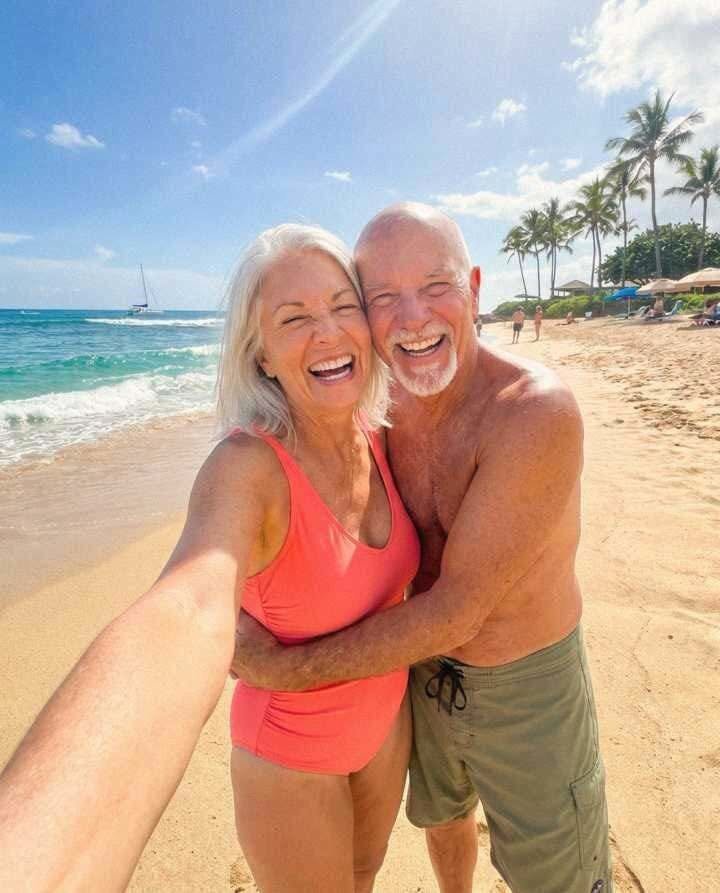
At sixty-seven, I had spent years believing that the most exciting chapters of my life were already behind me.

My husband, Michael, had been gone for four years after a long battle with cancer. For thirty-nine years, he had been my husband, my best friend, and the person I expected to grow old beside.

After his death, I became very good at being alone.

Then, on my sixty-seventh birthday, I made a decision.

I would take my first solo trip.

I chose Malta.

And I made myself one promise: I would say yes to everything that frightened me.

Yes to unfamiliar food.

Yes to conversations with strangers.

Yes to wandering down streets I had never seen.

Yes to laughter.

And perhaps most importantly, yes to the possibility of feeling alive again.

That was how I met David.

He was charming, funny, and unexpectedly attentive. We met in Valletta after I became hopelessly lost while searching for a small café.

“You look like someone who needs directions,” he joked.

I laughed.

“I probably do.”

He showed me the way, then invited me to join him for coffee.

I said yes.

That simple decision changed everything.

Over the next several days, David and I explored Malta together. We walked beside the sea, shared meals, visited old churches, and talked about our lives.

He was a widower too.

He told me about his late wife, Ruth, and I told him about Michael.

For the first time since my husband died, I felt something I thought I had forgotten how to feel.

Excitement.

On my final night in Malta, David suggested dinner at a quiet restaurant.

I followed him through a narrow passage into a dimly lit courtyard.

Then I heard a woman’s voice.

“You have to tell her before she leaves tomorrow.”

I stopped.

David answered quietly.

“I know.”

My heart began pounding.

The woman spoke again.

“You can’t keep doing this.”

I stepped into the courtyard.

David turned.

His face immediately lost its color.

“Who is she?” I demanded.

The woman looked at me with tears in her eyes.

“My name is Clara.”

David closed his eyes.

“She’s my daughter.”

I stared at him.

“Your daughter?”

He nodded.

Then he told me the truth.

Our meeting hadn’t been accidental.

David had recognized me from photographs online.

And the reason he had deliberately approached me was connected to something that had happened nearly four decades earlier.

Something involving my husband.

Michael had been having an affair with David’s late wife, Ruth.

For eleven years.

I felt as though the ground had disappeared beneath my feet.

Michael and I had been married for thirty-nine years.

I had cared for him during his illness.

I had held his hand during his final days.

And I had believed that I knew the man I married.

Now David was telling me that decades earlier, Michael and Ruth had maintained a secret relationship that stretched across several cities.

After Ruth died, David discovered a box hidden among her belongings.

Inside were more than forty letters from Michael.

There were photographs too.

Photographs of my family.

Photographs of a life I had believed was mine alone.

Then David handed me a faded envelope.

My name was written across the front in Michael’s unmistakable handwriting.

I couldn’t open it.

Not there.

Not with David watching.

Instead, I asked him the question that hurt most.

“Why did you come after me?”

David looked ashamed.

“At first, I wanted answers. I wanted to understand who Michael was and what happened between them.”

“And then?”

“I saw you in Valletta.”

He swallowed.

“You looked lost. I recognized you from photographs I’d found. I knew exactly who you were.”

“So our meeting was planned?”

“Not exactly. But I knew who you were. I should have told you.”

He admitted that he had initially approached me because of the secret connecting our late spouses.

But somewhere during those days together, his feelings had changed.

That didn’t make the deception disappear.

I took the envelope.

Then I walked away.

Back at my hotel, I finally opened Michael’s letter.

It was an apology written decades earlier.

He admitted that he had been unfaithful.

He admitted that he had confused escape with love.

He had never sent the letter to me.

Instead, he had given it to Ruth.

I cried until sunrise.

Not because I still loved Michael less.

But because the memories I had treasured suddenly had questions attached to them.

When I left Malta, I expected to feel only heartbreak.

Instead, something unexpected happened.

I realized that not everything beautiful about that trip belonged to David.

The laughter had been mine.

The courage had been mine.

The ocean had been mine.

The first bite of unfamiliar food had been mine.

The woman who had wandered through Valletta saying yes to life had been me.

David had not created that woman.

He had simply met her.

At the airport, David found me before my flight.

He handed me a book I had accidentally left behind.

“I know I hurt you,” he said. “I’m sorry. I won’t make excuses.”

He gave me his contact information.

“I don’t expect anything.”

I took the book.

Then I walked away.

When I returned home, I showed Michael’s letter to my daughter.

We cried together.

Then I began the slow work of separating my husband’s choices from my own life.

I went to therapy.

I joined new groups.

I traveled again.

And I stopped thinking of “yes” as a promise to accept everything life placed in front of me.

Sometimes saying yes was brave.

Sometimes saying no was even braver.

Ninety-three days after returning from Malta, I wrote David a letter.

I didn’t forgive him completely.

I didn’t forget what he had done.

But I asked whether we could meet again someday without the ghosts of Michael and Ruth standing between us.

He agreed.

Over the following year, we built something entirely different from what we had started with.

There were no secrets.

No investigations.

No hidden letters.

Just two older people learning whether they could love each other without being defined by the mistakes of those who came before them.

A year later, I returned to Malta.

When I stepped into the arrivals hall, David was waiting.

He held a sign.

ARE YOU STILL SAYING YES?

I smiled.

Then I took a pen from my handbag.

I crossed out one word.

And changed it.

SOMETIMES.

David laughed.

So did I.

Because at sixty-eight, I finally understood something I had spent my whole life learning.

Being brave doesn’t mean saying yes to everything.

It means knowing that you are allowed to choose.

And after everything I had lost, discovered, and survived, that choice was the greatest freedom of all.

Leave a Reply

Your email address will not be published. Required fields are marked *