
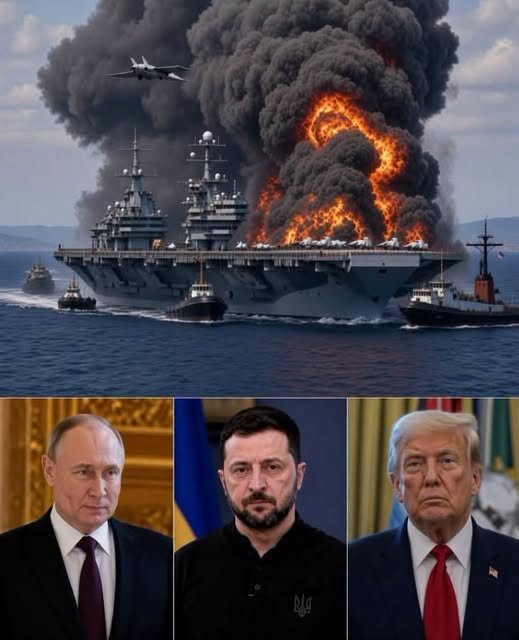
BREAKING: Shocking reports are circulating that a Russian Su-57 stealth fighter pilot has allegedly carried out a devastating strike on a… Sudden Strike on Fortified Vessel Signals Crisis in Modern Naval Defense
In an era defined by advanced surveillance and automated protection, early unconfirmed reports of a devastating strike against a heavily protected vessel have sent shockwaves through the global community. The attack was reportedly executed with such extreme velocity that sophisticated defensive systems were unable to intercept the threat, resulting in what many fear are catastrophic losses.
This breach of a high-value fortified target has prompted immediate and intense scrutiny from defense analysts, who are now forced to reconcile the failure of modern technology against emerging offensive capabilities.As the world awaits official confirmation from government authorities, the vacuum of information is being filled by rapid speculation across social networks.
This digital frenzy has exacerbated existing tensions, fueling widespread concern over a potential escalation between major world powers. In light of these developments, geopolitical experts are stressing the importance of verifying facts to prevent the spread of misinformation, which could lead to unintended diplomatic or military consequences.
Should these reports be verified, the incident would mark a pivotal shift in the landscape of modern warfare. It highlights a disturbing reality: even the most secure military assets possess vulnerabilities that can be exploited by rapid-response strikes. Such a development would likely necessitate a total overhaul of global military strategy and a redistribution of the balance of power.
Currently, the international community remains on high alert as investigators and think tanks analyze the data to determine if this event represents a singular anomaly or the beginning of a dangerous new chapter in international relations.
A claim involving a Su-57 and an American aircraft carrier would have consequences far beyond a single battlefield. Carriers operate with escorts, aircraft, surveillance systems, and layered defenses. Serious damage would generate emergency communications, visible changes in naval activity, and statements from several governments. The absence of those supporting details is a major gap in the circulating account.
The number of people said to be aboard also demands careful treatment. Casualty claims can spread quickly during a crisis, but families and military authorities require verified information before names or totals are released. Repeating an unconfirmed figure can cause unnecessary panic and complicate official notification procedures.
Images offered as proof may come from exercises, older fires, video games, or unrelated conflicts. Aircraft silhouettes are often mislabeled, and dramatic footage can be edited together without showing a continuous event. Analysts would normally examine location data, satellite imagery, ship movements, and official records before accepting such an extraordinary report.
The Su-57 is designed as an advanced Russian fighter, but identifying an aircraft does not prove who flew it, what weapons it carried, or what target it engaged. Those questions require evidence from more than a social-media caption.
Until attributable confirmation appears, the story should be understood as a circulating allegation. The scale of the claim makes verification more necessary, not less. A real strike of this magnitude would produce extensive, independent reporting and a visible government response; without that record, speculation should not be allowed to harden into fact.