
In moments of danger, the difference between life and tragedy can come down to a single action.
Sometimes, that action comes from a person trained to respond.
Sometimes, it comes from someone who has spent years preparing for emergencies.
And sometimes, it comes from an unexpected source — a creature that simply recognizes that another living being is in trouble and chooses to help.
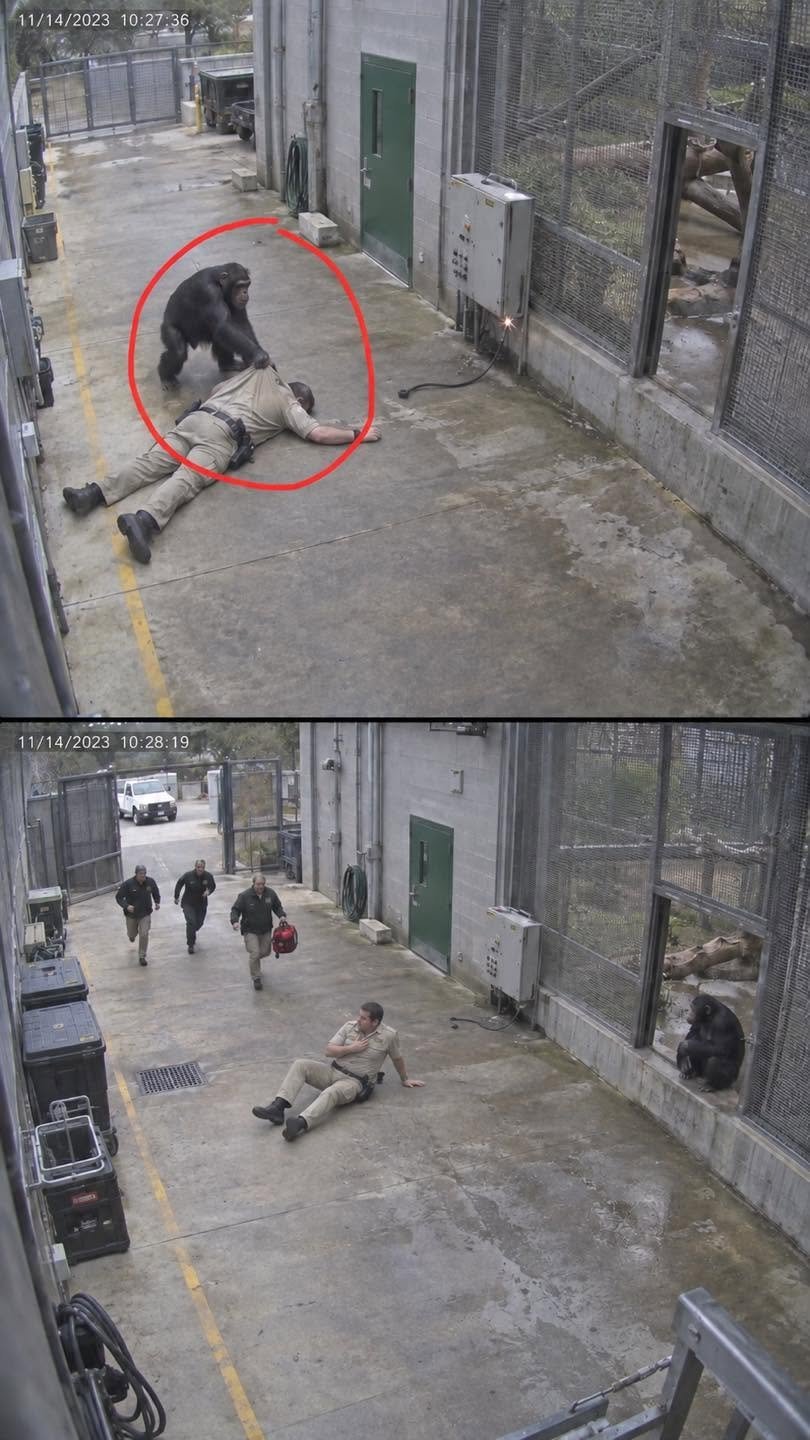
That is what happened when a chimpanzee at a zoo became an unlikely hero, stepping forward during a dangerous accident and helping save the life of a zookeeper.
The animal was not trained for rescue.
It was not following a command.
It was not performing for attention.
It simply saw someone it knew lying helplessly in danger — and reacted.
A Routine Task That Turned Into a Life-Threatening Emergency
The day began like many ordinary workdays for the zookeeper.
His job required constant attention to the animals, their environment, and the equipment that kept the facility operating safely. Like many workers behind the scenes at zoos, he often handled tasks that visitors never saw — checking systems, inspecting equipment, and making sure everything was functioning properly.
On this particular day, he entered a service area located beside the chimpanzee habitat to inspect a control cabinet that had suddenly stopped working.
It appeared to be a routine maintenance issue.
But hidden inside the equipment was a serious danger.
When the keeper opened the electrical cabinet, a fault occurred.
The sudden electrical problem knocked him to the ground.
The impact left him conscious but confused. He was aware of what had happened, but the shock and disorientation made it difficult for him to move. The faulty equipment remained nearby, with loose electrical components creating a dangerous situation.
Every second mattered.
He needed to get away from the source of danger.
But he could not do it alone.
The Chimpanzee That Refused to Look Away
Nearby, a chimpanzee was watching.
From the access doorway beside the habitat, the animal noticed something was wrong.
Chimpanzees are known for their intelligence, emotional awareness, and ability to recognize individuals within their social groups. They can form strong connections, remember familiar faces, and respond to unusual situations around them.
The chimpanzee became visibly agitated.
Something about the scene was different.
A familiar human was on the ground.
The keeper was not moving normally.
There was danger nearby.
Instead of staying away, the chimpanzee moved toward the service area.
It entered the yard.
Then it approached the injured keeper.
What happened next surprised everyone watching.
The chimpanzee grabbed the back of the keeper’s jacket and began pulling.
An Untrained Rescue Driven by Instinct
The chimpanzee pulled with determination.
The keeper was not lightly moved at first. The concrete surface made the effort difficult, but the animal continued.
Slowly, it dragged him several feet away from the dangerous electrical area.
Away from the loose cable.
Away from the immediate threat.
The chimpanzee did not appear to understand electricity or the technical danger surrounding the equipment. It did not know how to turn off the power or call for help.
But it understood something important.
The person was in danger.
And moving him away was the only solution it could find.
Once the keeper was safely away from the electrical hazard, the chimpanzee released his clothing and returned toward the habitat entrance.
It did not wait for praise.
It did not seek attention.
It simply stepped back.
Almost as if it knew the most important thing had already been done.
The Rescue Team Arrives
The emergency was noticed by other zoo workers through a security monitor.
They immediately recognized that something serious had happened and contacted the rescue team.
Within moments, responders rushed through the service gate carrying medical equipment.
Three emergency workers arrived and began assisting the keeper.
By that point, he had regained enough strength to sit upright, but he was still recovering from the shock.
Standing nearby was the chimpanzee.
The animal remained close to the habitat doorway, quietly observing as the humans provided assistance.
For the workers who witnessed the event, the most remarkable part was not only what the chimpanzee had done.
It was why it had done it.
No one had trained the animal to perform a rescue.
There was no instruction.
No reward.
No expectation.
The chimpanzee had simply reacted to a dangerous situation involving someone familiar.
A Reminder of the Intelligence and Compassion of Animals
Stories like this often cause people to reconsider how they view animals.
For a long time, some people saw animals mainly through the lens of instinct. They survived, searched for food, protected themselves, and responded to immediate needs.
But research into animal behavior has shown that many species demonstrate complex emotions and social intelligence.
Chimpanzees, in particular, are among the closest living relatives of humans. They share many behavioral similarities with people, including cooperation, problem-solving, communication, and strong social bonds.
They can remember relationships.
They can react emotionally to the suffering of others.
The actions of this chimpanzee offer another powerful example of how animals can sometimes display behaviors that seem deeply connected to empathy and concern.
The animal did not think like a human.
It did not understand the situation the way the rescue workers did.
But it recognized that something was wrong.
And it acted.
The Bond Between Humans and Animals
The relationship between humans and animals has always been complicated and meaningful.
Throughout history, animals have helped people in countless ways.
Dogs have guided people who cannot see.
Horses have carried humans through difficult environments.
Dolphins have been reported to assist humans in distress.
And countless pets have provided comfort during moments of loneliness and emotional pain.
But perhaps the most touching examples are those moments when animals appear to help not because they have been trained, but because they have formed a connection.
The chimpanzee did not see the zookeeper as just another person.
It recognized someone familiar.
Someone connected to its daily life.
Someone who was suddenly vulnerable.
That connection may have been the reason behind an action that changed the outcome of a dangerous accident.
The Animal Who Showed What Compassion Looks Like
The rescue team treated the keeper and helped him recover from the accident.
But before the professionals arrived, before the equipment was brought in, and before emergency procedures began, the first rescue had already happened.
It came from an unexpected hero.
A chimpanzee.
An animal that saw danger.
An animal that saw a person unable to escape.
An animal that chose to help.
The story serves as a reminder that compassion can appear in surprising places. It reminds us that intelligence is not measured only by language or technology, and kindness is not limited to humans.
Sometimes, a simple act of courage says more than words ever could.
The chimpanzee did not know it was becoming a hero.
It was simply doing what it felt was necessary.
And perhaps that is what makes the story so powerful.
The greatest acts of kindness are often not planned.
They happen in a moment when one living being sees another in need — and chooses not to walk away.
The Zookeeper’s Relationship With the Animal
Animals do not usually respond deeply to people they have never encountered. Trust develops through repeated experiences.
For the zookeeper, caring for chimpanzees was likely more than simply completing a job.
Working with intelligent animals requires patience, consistency, and understanding. Keepers spend years learning individual personalities, recognizing behaviors, and building trust.
Each animal has its own temperament.
Some may be playful.
Some may be cautious.
Some may be highly social.
The relationship between keeper and animal grows through daily care.
Feeding.
Monitoring health.
Maintaining the habitat.
Creating a safe environment.
Over time, the animal begins to recognize that this person is part of its world.
That connection may have played an important role in what happened during the emergency.
The chimpanzee was not helping a stranger.
It was helping someone familiar.
A Story That Reminds Us to Respect Every Living Being
The rescue also carries a larger message about the way humans view animals.
For centuries, people have often placed humans above other species, seeing animals primarily as creatures driven only by instinct.
But stories like this encourage a deeper understanding.
Animals may experience the world differently from us, but they are not empty of emotion or intelligence.
They form relationships.
They remember.
They react.
They communicate in ways humans are still learning to understand.
The chimpanzee’s action does not mean animals think exactly like humans.
It does not mean every animal will respond the same way in every situation.
But it does show something important:
The natural world is far more complex than many people realize.
There are moments of connection that cannot be easily explained.
Moments where the distance between species feels smaller.
The Hero No One Expected
When emergency workers arrived, they came prepared with medical equipment and training.
They knew exactly what steps to take.
But before they reached the scene, the most important action had already happened.
A chimpanzee had created distance between a person and danger.
The animal would never understand the attention the story received afterward.
It would never read headlines.
It would never hear people call it a hero.
But perhaps that is what makes the moment even more meaningful.
The chimpanzee was not trying to become extraordinary.
It was simply responding with what it had.
A moment of awareness.
A moment of connection.
A moment of action.