Every morning before sunrise, a silver whistle echoed through our neighborhood.

Then came silence.

At first, that silence bothered me. It felt unnatural. Like something was happening behind the tall cedar fence next door that nobody wanted to talk about.

When my husband Mark and I moved into our new home, we thought we had found the perfect place.

Quiet street. Good schools. Big backyard.

The rent was almost too affordable, and we joked that there had to be some hidden problem.

We never expected the problem would be the family living beside us.

While unloading boxes, an elderly neighbor watering her roses looked toward the house next door.

“You picked the house beside David?”

Mark smiled politely.

“Yes. Is there something wrong?”

The woman hesitated.

“I guess you’ll find out.”

Before we could ask more, she walked away.

Later that afternoon, another neighbor arrived with cookies. She started with a warm smile, but it quickly disappeared.

“Nobody warned you?”

“Warned us about what?” I asked.

She glanced toward the cedar fence.

“The father.”

I frowned.

“What about him?”

“He’s raising seven children alone.”

I stared at her.

“Seven?”

She nodded.

“The oldest is sixteen. The youngest is five.”

“That must be difficult.”

“It is.”

Then she lowered her voice.

“You’ll hear the whistle every morning.”

The next day, exactly at five o’clock, I heard it.

A sharp whistle cut through the quiet.

I expected shouting. Complaints. Children refusing to get out of bed.

Instead, there was silence.

I stepped outside.

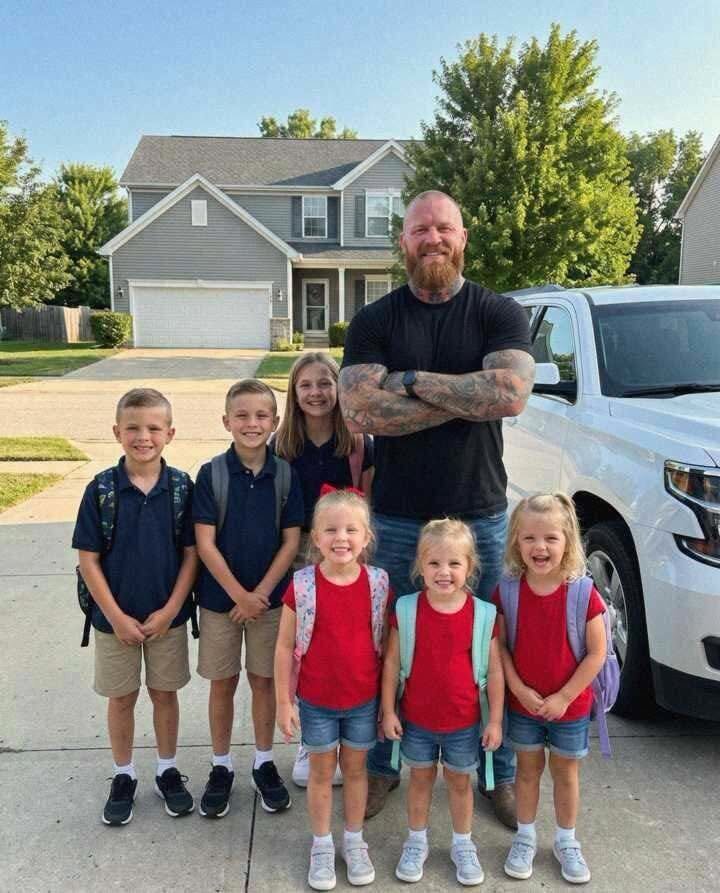
Seven children stood in a straight line in their backyard.

The oldest girl stood at the front. The younger children followed behind her, still sleepy and quiet.

David stood facing them with a clipboard.

He looked to be in his early forties. Tall. Serious. Gray already showing in his dark hair.

He didn’t yell.

He didn’t need to.

He checked shoes, clothing, and even fingernails. Then he marked something on his clipboard.

Next, he spun a wooden wheel attached to the porch.

Different chores appeared.

Garden.

Laundry.

Breakfast.

Bathrooms.

Chicken coop.

Trash.

Repairs.

The children nodded and disappeared.

No arguing.

No complaints.

No laughter.

Mark watched beside me.

“They’re organized.”

“They’re scared,” I whispered.

Every morning followed the same pattern.

Whistle.

Line.

Inspection.

Chores.

School.

The older children taught the younger ones everything.

How to cook.

How to fold clothes.

How to budget grocery money.

How to repair bicycles.

The youngest boy, Ben, struggled with buttons on his shirt. His older sister patiently helped him.

David watched quietly.

He never praised them.

He never hugged them.

The neighborhood had already decided what they thought.

“They live like they’re in a military camp.”

“He’s too strict.”

“Those children never get to be children.”

One afternoon, I asked the mail carrier about him.

“You’ve known David for years. Is he always like this?”

The man sighed.

“I’ve never seen him hurt those kids.”

“But?”

He looked toward the house.

“But I’ve never seen him hug them either.”

That answer stayed with me.

A week later, I found little Ben standing near our fence, staring at my tomato plants.

“Hi,” I said.

He jumped.

“Those are big.”

“They’re almost ready.”

He smiled.

For the first time, I saw one of David’s children look happy.

“What’s your name?”

“Ben.”

“I’m Claire.”

He pointed at the plants.

“My sister says those are determinate tomatoes.”

I laughed.

“Your sister taught you that?”

He nodded proudly.

“Emma teaches us everything.”

Before I could answer, the whistle sounded.

Ben immediately turned around and ran home.

David stood on the porch.

He wasn’t angry.

He simply waited.

That night, Mark found me watching the house again.

“You’re judging him.”

“Everyone is.”

“Maybe everyone is only seeing a small part of their life.”

I wanted to believe him.

Then an ambulance arrived.

Every child calmly walked outside.

Nobody screamed.

Nobody panicked.

The oldest daughter, Emma, handed the paramedics a folder before they reached the door.

David was examined but refused the hospital.

The next morning, the whistle still sounded.

But something had changed.

Emma carried the folder everywhere.

The older children carried notebooks.

The younger ones practiced phone numbers.

One afternoon, I heard David through the open window.

“Again.”

A child answered.

“My name is Lily. My father isn’t breathing. There are seven children in the house. Our address is…”

“Again.”

She repeated it.

Over and over.

I felt uncomfortable.

It wasn’t normal.

It sounded like preparation.

A few days later, I saw them sitting around a table with large binders.

Emergency plans.

David asked questions.

“What happens if the electricity goes out?”

“The breaker gets checked first.”

“What happens if someone knocks after dark?”

“We don’t open the door.”

“What happens if Ben gets sick?”

“Medicine first. Hospital if needed.”

Then Mark looked at me.

“He’s training them.”

“For what?”

We didn’t know.

Until three days later.

I heard a crash from the other side of the fence.

Then David’s voice.

A weak groan.

A child shouted:

“Plan Red!”

Everything happened instantly.

The children moved like they had practiced it hundreds of times.

Emma checked her father.

One child called emergency services.

Another unlocked the gate.

The youngest children stood together exactly where they had been instructed.

No panic.

No confusion.

They knew what to do.

I climbed over the fence.

The paramedics arrived quickly.

One looked at Emma.

“You’ve done this before.”

She nodded.

“Three times.”

Then the medical folder slipped from her hands.

I helped pick up the papers.

One page stopped me.

“Emergency care plan for seven dependent children.”

Another page listed medications.

Then I saw the diagnosis.

Stage IV pancreatic cancer.

Diagnosed nine months earlier.

My heart sank.

All those rules.

All those drills.

They weren’t about control.

They were about survival.

Emma looked at me.

“He isn’t teaching us how to obey him.”

Her voice shook.

“He’s teaching us how to live when he can’t tell us what to do anymore.”

Two days later, she invited me inside.

For the first time, I entered David’s house.

The schedules on the walls.

The emergency plans.

The chore system.

Everything I had judged suddenly looked different.

It wasn’t a prison.

It was a father fighting time.

David sat in a chair by the window.

“I suppose Emma couldn’t hide the paperwork forever.”

“I’m sorry,” I said.

He smiled sadly.

“Most people apologize after they realize they judged me.”

I looked down.

“I did.”

“I know.”

Emma handed him a black notebook.

David gave it to me.

“Read the last pages.”

It wasn’t a diary.

It was a lesson plan.

“Emma cooks dinner alone. Passed.”

“Noah changes a tire. Needs practice.”

“Lily calls emergency services without crying. Passed.”

“Ben remembers important phone numbers. Passed.”

Every page was a father preparing his children for a future without him.

The final page had one sentence.

“The goal isn’t to make them need me forever. It’s to make sure they won’t need anyone when I’m gone.”

I wiped my eyes.

“You prepared them for everything.”

David looked toward the kitchen.

“I prepared them to survive.”

Then he paused.

“But I forgot to teach them they wouldn’t be alone.”

That changed everything.

The neighborhood stepped in.

The electrician taught the boys repairs.

The nurse helped with medical needs.

The accountant taught Emma finances.

The mechanic taught the children basic car maintenance.

Nobody called it charity.

They called it being neighbors.

Slowly, David stopped preparing them to live without him.

He started helping them live with others.

Winter came.

The whistle sounded later each morning.

Sometimes Emma blew it.

The children still lined up.

Not because they were afraid.

Because it reminded them they were a family.

Six weeks later, David passed away.

Emma called me first.

By sunrise, the neighborhood filled his kitchen.

Nobody had to ask them to come.

They simply came.

At the funeral, people stood and admitted the truth.

“We thought we knew him.”

“We were wrong.”

Afterward, the children returned home.

The house felt empty.

Ben looked at the chair where David used to sit.

“Who’s going to blow the whistle now?”

Emma hugged him.

Then she reached into David’s old jacket and pulled out the silver whistle.

She blew one short note.

Every child turned.

Not with fear.

With trust.

They began setting the table together.

One poured drinks.

One carried plates.

One stirred soup.

Emma watched them and whispered:

“He made sure we’d never have to do this alone.”

Months later, I still wake before sunrise sometimes.

I wait for the whistle.

It never comes.

But when I look outside, I see seven children walking through life together.

The whole neighborhood once believed the silver whistle meant control.

We were wrong.

It was never the sound of fear.

It was the sound of a father racing against time to teach his children how to love, survive, and stand together long after he was gone.

Leave a Reply

Your email address will not be published. Required fields are marked *