
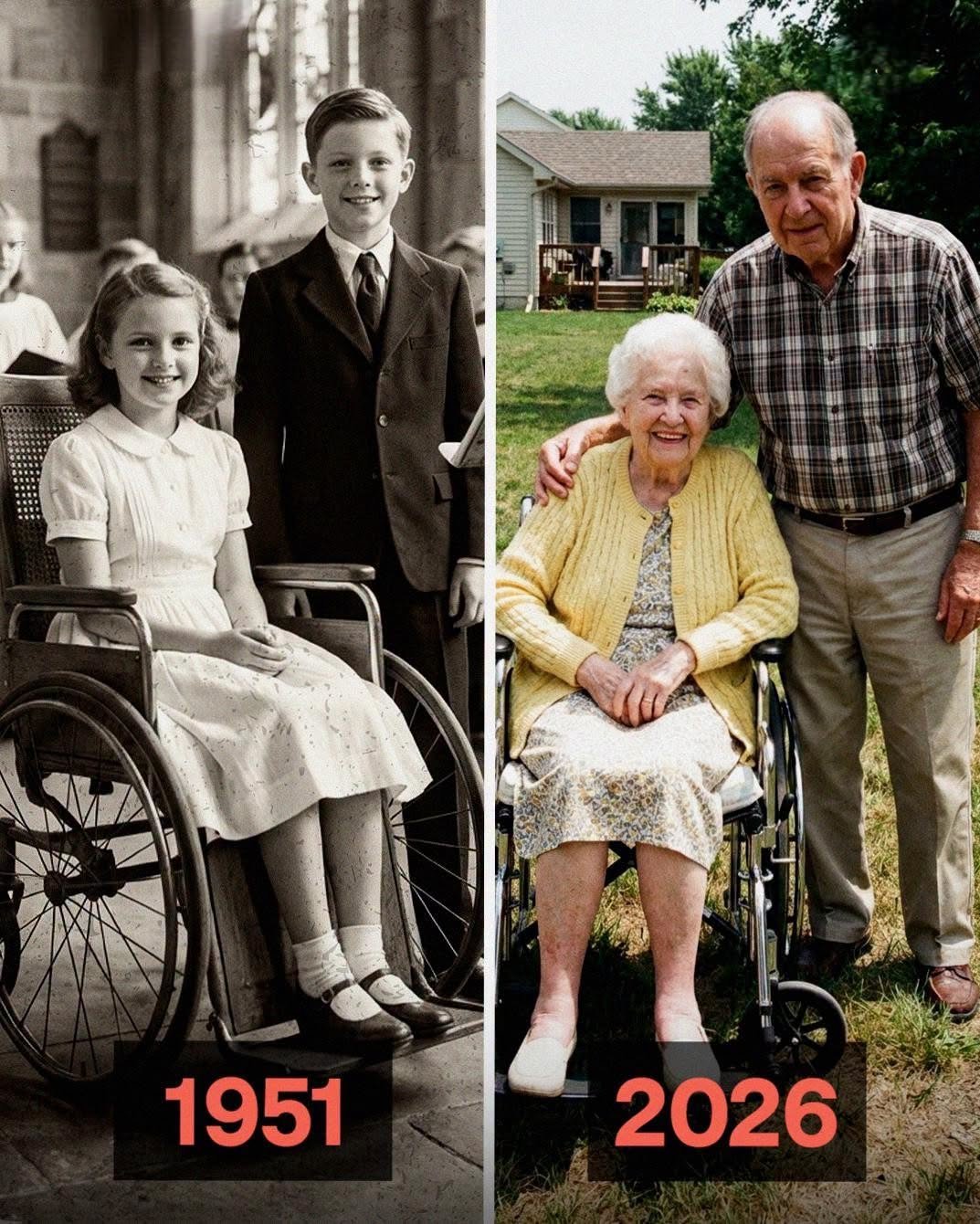
After 65 years of marriage, I believed there were no surprises left.
At 85, I had spent more of my life with Martin than without him. I knew the way he took his coffee, the way he hummed when he was nervous, and the way he always checked the front door twice before going to bed.
I thought I knew every chapter of his story.
I was wrong.
Martin and I met when we were children in a church choir. I was already using a wheelchair, and by then I was accustomed to people treating me differently.
Some stared.
Some spoke to me too loudly.
Some acted as though my wheelchair was the first thing they noticed and the last thing they could see.
Martin was different.
He simply said hello.
No hesitation. No pity. No awkward questions.
Just hello.
That small moment became the beginning of everything.
We grew up together. Martin pushed my chair when I needed help, but never made it seem like an obligation. He sat beside me when others walked away. He made me laugh when I was angry and stayed when life became difficult.
When he proposed, there was no grand speech.
He simply took my hand and said, “I don’t want to do life without you.”
So we didn’t.
We married young and built an ordinary life that, looking back, feels extraordinary.
There were children, holidays, bills, arguments about money, birthdays, illnesses, grandchildren, and countless quiet evenings sitting beside each other.
Our daughter, Jane, came first. Then our son, Jake. Eventually, they brought grandchildren into our lives, filling our home with noise again.
Martin wasn’t perfect.
Neither was I.
But I believed our love was honest.
Then, after 65 years together, I watched him die.
I held his hand during his final hours.
There were so many things I wanted to say, but when the moment came, all I could manage was, “I’m right here.”
He squeezed my hand weakly.
Then he was gone.
Afterward, the house became unbearably quiet.
His chair remained beside the window.
His glasses stayed on the table.
His favorite mug sat beside the coffee maker.
I couldn’t move any of it.
People told me I needed to let go.
But how do you let go of someone who has been part of almost every memory you possess?
Months passed.
Then Jane came over one afternoon.
“We should start sorting Dad’s office,” she said gently.
I didn’t want to.
But eventually, I agreed.
We began with paperwork, old receipts, photographs, and documents. Then Jane opened a cabinet and started organizing folders.
That’s when I noticed something I’d never seen before.
A locked drawer.
I stared at it.
“Dad had a locked drawer?”
Jane looked surprised.
“I didn’t know.”
Neither did I.
In 65 years of marriage, Martin had never kept a drawer locked.
I remembered that he always carried several keys on a small ring. After his funeral, I’d found them in the pocket of his old jacket.
I went to the bedroom and brought them back.
The third key fit.
The drawer opened with a soft click.
Inside was a stack of envelopes.
Dozens of them.
Some were yellowed with age. Others looked newer.
My hands began to tremble.
Then I saw the name written on one envelope.
Dolly.
I hadn’t heard that name in decades.
But I remembered her.
Not clearly.
Just fragments.
A young woman from Martin’s past. Someone he’d known before we married.
I opened the first letter.
The words at the top made my heart stop.
“She still talks about you in her sleep.”
I read it twice.
Jane stood beside me.
“Mom?”
I couldn’t answer.
We opened another.
Then another.
The letters stretched across decades.
There were years between some of them.
Martin wrote about our children, our grandchildren, birthdays, illnesses, family celebrations and ordinary moments.
He told Dolly about my favorite recipes.
He told her about Jane’s wedding.
He described Jake’s first job.
He even wrote about the day our first grandchild was born.
Dolly wrote back.
One letter said:
“I don’t know how to fix something that has been broken this long.”
I expected to feel betrayed.
Instead, I felt confused.
Because as we read more, one thing became increasingly clear.
There had been no secret affair.
No hidden marriage.
No second family.
Something else had been happening.
Something much older.
Something unfinished.
Martin and Dolly had been childhood friends before his life with me. They had loved each other once, but circumstances had separated them.
According to the letters, Dolly had eventually married someone else.
Martin had married me.
And both had continued with their lives.
But they had never completely stopped wondering about each other.
I found the most recent letter.
It had been written only a few months before Martin died.
He wrote:
“I don’t know how much time I have left. I need to know she’s okay.”
At the bottom was an address.
Jane looked at me.
“Do you want to go?”
I didn’t know.
But the next morning, we did.
The drive was strangely quiet.
I had imagined anger.
Instead, I felt sadness.
When we arrived, an elderly woman opened the door.
She looked at me.
I looked at her.
For several seconds, neither of us spoke.
Then her eyes filled with tears.
“You’re Martin’s wife,” she whispered.
“Yes.”
She lowered her head.
“I wondered if this day would ever come.”
I expected an explanation.
Instead, Dolly said something I never expected.
“Martin loved you.”
That sentence broke something open inside me.
She invited us in.
We spent hours talking.
Dolly told me that Martin had never promised her a future. He had never deceived me about where his life belonged.
But he had remained connected to her because their shared past had never completely disappeared.
“He always told me about you,” Dolly said. “He was proud of you.”
I looked down at my hands.
“Then why hide the letters?”
She sighed.
“Because he was afraid you’d think you weren’t enough.”
That hurt more than I expected.
Because after 65 years, I had never believed I was competing with anyone.
And I still wasn’t.
Martin hadn’t been living two lives.
He had simply carried one unfinished piece of his past into the life we built together.
On the drive home, I stared out the window.
I wasn’t angry.
I wasn’t completely at peace either.
But I understood something I hadn’t understood before.
A person can love you completely and still have memories that belong to another chapter.
That doesn’t make your love less real.
Martin had chosen me.
He had built a home with me.
He had raised children with me.
He had held my hand for 65 years.
And perhaps the letters didn’t change that.
Perhaps they made the story more human.
Before he died, Martin had left me one final lesson without ever intending to.
People are complicated.
Love is complicated.
And sometimes the truth doesn’t arrive to destroy what we believed.
Sometimes it arrives simply to show us that there was more to understand.
I still miss him every morning.
I still reach toward his empty side of the bed sometimes.
But now, when I think about those letters, I don’t think about betrayal.
I think about a young man who once loved a girl named Dolly, then grew up and spent 65 years loving me.
Both things can be true.
And maybe that’s what I needed to learn.
Even after a lifetime together, there can still be secrets.
Not every secret is a betrayal.
Some are simply unfinished pieces of a life.
And sometimes, when we finally discover them, they don’t take love away.
They help us understand just how complicated—and beautiful—that love really was.