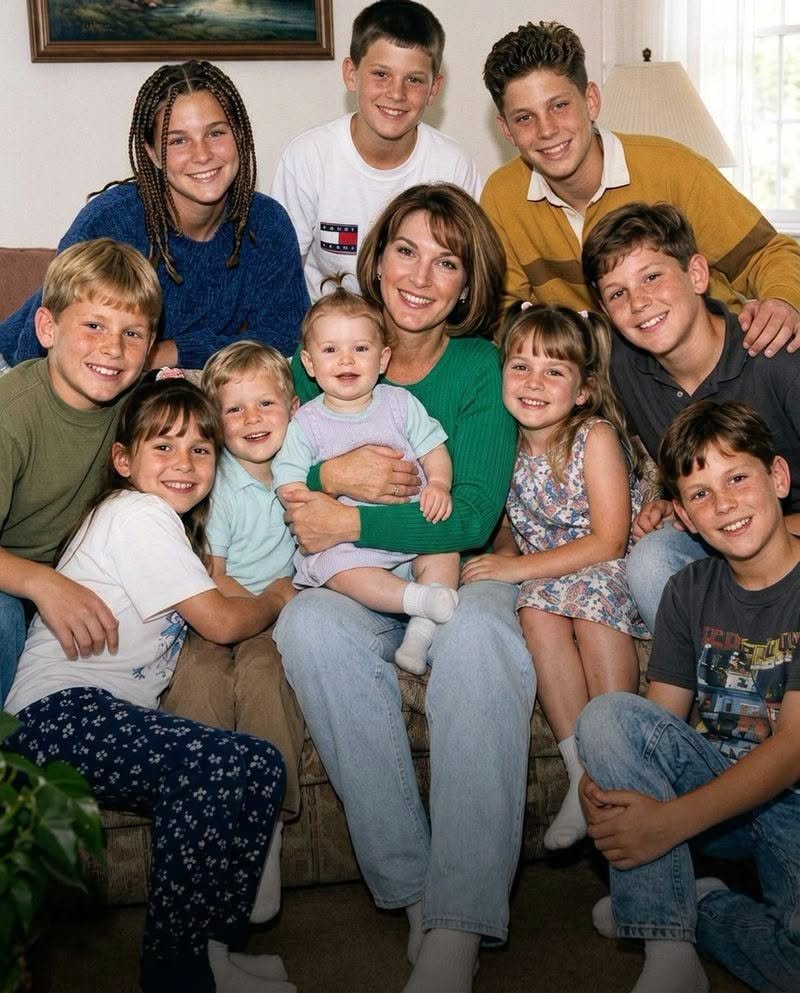
I never expected to become a mother to ten children.

I certainly never expected to raise them alone.

And I never imagined that, thirty years after the man I loved walked out of our lives without explanation, his attorney would appear at my front door carrying an envelope that would finally explain everything.

But that is exactly what happened.

It all began in a grocery store.

Robert was standing in the checkout line with a shopping cart overflowing with cereal, bread, milk, canned vegetables, and enough snacks to feed a small army.

Ten children will do that to a grocery bill.

A tiny toddler reached toward me with both arms.

Robert looked embarrassed as he lifted her.

“I’m sorry,” he said. “She does that whenever someone smiles at her.”

I laughed.

“Then I suppose I’ll keep smiling.”

The little girl giggled.

Her name was Sophie.

And somehow, that tiny exchange changed my life.

Robert was a widower.

His wife had died two years earlier, leaving him alone with ten children.

The oldest was Amanda.

Then came Sue, Jacob, David, Derrick, and the four energetic younger children who seemed to move as one enormous, noisy unit.

And Sophie was the youngest.

Robert looked exhausted.

But he was trying.

I could see that immediately.

I started talking to him whenever I saw him at the store.

Then we had coffee.

Then dinner.

Then I began visiting his house.

At first, I told myself I was only helping.

But eventually I realized something.

I hadn’t simply fallen in love with Robert.

I had fallen in love with all ten children.

Amanda was already acting like a second mother.

Sue talked with her entire body whenever she got excited.

Jacob and David turned every chore into a competition.

The quadruplets were incapable of sitting still.

And Sophie began calling me Mama without anyone teaching her to.

Six months later, Robert proposed.

There was nothing glamorous about it.

We were eating meatloaf and mashed potatoes while ten children pretended not to listen from the hallway.

Robert looked across the table.

“Will you marry us?”

I burst into tears.

“Yes.”

My mother thought I had lost my mind.

“Ten children, Margaret,” she warned me. “You haven’t even lived your own life yet.”

“They are my life.”

“You’re making a terrible mistake.”

Maybe I was.

But if I was, it was the most beautiful mistake I ever made.


Two weeks before the wedding, Amanda helped zip my dress.

Sophie stood nearby clapping.

The boys were making exaggerated gagging noises from the doorway.

Then I saw Robert’s reflection in the mirror.

He was watching me quietly.

“You look beautiful,” he said.

“You aren’t supposed to see the dress.”

“I know.”

He smiled.

“I just wanted to remember.”

I laughed.

At the time, I thought he was simply being sentimental.

Years later, I would realize he had already been carrying a secret.

Something he hadn’t told me.

Something that would change all of our lives.


The morning Robert disappeared, I knew immediately that something was wrong.

His truck was gone.

His phone was turned off.

His side of the bed was cold.

There was no warning.

No argument.

No goodbye.

Only a note beneath the sugar bowl.

Three sentences.

I’m sorry.

I can’t do this anymore.

Please forgive me.

That was it.

I read it three times.

Then Sophie walked into the kitchen wearing her pajamas.

She wrapped both arms around my leg.

“Mama, juice?”

I looked down at her.

Then toward the stairs.

Ten children were waking up.

Ten frightened faces would soon be looking for their father.

And suddenly, my heartbreak wasn’t the most important thing in the room.

My mother called that afternoon.

“This is a sign,” she said. “Let the authorities take the children.”

“They’re upstairs.”

“They aren’t your responsibility.”

“They call me Mama.”

“You’re still young, Margaret.”

I looked around the kitchen.

Ten pairs of eyes were watching me.

“I can’t leave them.”

My mother sighed.

“You’re throwing your life away.”

Maybe she was right.

But I knew what I was going to do.

I went to the county office.

A social worker looked at me carefully.

“Ten children is an enormous responsibility.”

“I know.”

“You’re allowed to say you can’t do this.”

“I know.”

She slid the paperwork toward me.

I picked up the pen.

“They already call me Mama.”

I signed.

The guardianship eventually became adoption.

But honestly, they became my children that day.


The years that followed were difficult.

There were no dramatic montages.

There were bills.

Laundry.

Fevers.

Broken appliances.

School projects.

Grocery shortages.

Late-night homework.

I worked at a fabric warehouse during the day.

At night, I sewed school uniforms and repaired clothing for extra money.

Amanda learned how to cook.

Derrick became the family’s handyman.

Sue took charge of laundry.

Jacob and David argued over everything.

The younger children grew up surrounded by noise, arguments, laughter, and love.

There were moments when I was exhausted enough to sit on the kitchen floor and cry.

But someone always found me.

“Mama?”

And I’d wipe my face.

“I’m okay.”

Eventually, I stopped dating.

A few men tried.

Then they heard the number ten.

“Ten children?”

And they disappeared.

Eventually, I stopped caring.

My life wasn’t empty.

It was full.

Too full sometimes.

But full.

Graduations came.

Then weddings.

Then grandchildren.

Amanda became a nurse.

Sue became a teacher.

Jacob and David became engineers.

Derrick opened an auto repair shop.

The younger ones built lives of their own.

And somehow, thirty years disappeared.


Then one Saturday morning, someone knocked on my front door.

I opened it to find a man in a gray suit holding a leather folder.

“My name is Mr. Johnson,” he said.

Something about his expression made my stomach tighten.

“Are you Margaret?”

“Yes.”

He nodded.

“I was Robert’s attorney.”

I couldn’t breathe.

Robert.

I hadn’t heard that name spoken by a stranger in decades.

He reached into his folder and removed an envelope.

“My instructions were very specific.”

He handed it to me.

“He asked me to deliver this to you exactly thirty years after his departure.”

My hands trembled.

My name was written across the front.

I knew the handwriting immediately.

The room behind me went silent.

My children had gathered in the hallway.

I opened the envelope.

And finally, after thirty years, Robert told me the truth.


He had been dying.

Months before our wedding, doctors had discovered a serious illness.

They told him he might have only months to live.

There was an experimental treatment.

It might work.

It might not.

And even if it did, there were no guarantees.

Robert wrote that he became terrified.

Not of dying.

Of what his death would do to me.

He imagined marrying me, building a family together, and then leaving me with ten grieving children and enormous medical bills.

He believed I would spend the rest of my life caring for children who weren’t biologically mine while mourning the man who had brought them into my life.

So he made the decision for all of us.

He left.

He wrote:

“I thought leaving would hurt you less than staying long enough to make you lose me.”

I had to put the letter down.

For thirty years, I’d believed he simply abandoned us.

Now I discovered that he had been afraid.

But the next part was even harder.

The treatment worked.

Robert survived.

Two years after leaving, he came back.

Not to the house.

He stayed across the street.

He saw Amanda carrying groceries.

He saw Derrick teaching the twins how to repair a bicycle.

He saw Sophie running toward me.

He heard her shout:

“Mama!”

And he drove away.

He believed that returning would destroy the family we had built.

So he stayed away.

For thirty years.

He never remarried.

He never had more children.

Instead, he quietly followed our lives from a distance.

He knew about the graduations.

The weddings.

The careers.

The grandchildren.

Every milestone.

He had created a trust for all ten children.

But the money wasn’t the part that broke me.

It was the final paragraph.

“I know I don’t deserve forgiveness. I know I cannot ask you to erase thirty years of pain with one letter. But I hope someday you will understand that leaving was never because I didn’t love you.”

Then came the sentence that made me cry.

“You gave them the life I was too afraid to give them myself.”


I looked around my kitchen.

Amanda was crying.

Sue had both hands over her mouth.

Jacob stared at the floor.

David wiped his eyes.

Sophie, now a grown woman with children of her own, reached for my hand.

For thirty years, I had wondered why I hadn’t been enough to make Robert stay.

Now I understood something.

His decision hadn’t been about my worth.

It had been about fear.

Whether that made what he did right was another question.

It didn’t.

His absence still hurt.

There were birthdays he missed.

Graduations.

Weddings.

Grandchildren he never held.

A thousand ordinary moments that could never be returned.

But for the first time, I could understand the man behind the decision.

And sometimes understanding is different from excusing.

I folded the letter carefully.

Then I looked around the table.

Ten children.

Their spouses.

Their children.

A house filled with people who existed because, thirty years earlier, I had refused to walk away.

I lifted my teacup.

“To Robert,” I said quietly.

Amanda smiled through her tears.

Then she lifted hers.

“And to Mama.”

One by one, everyone raised their cups.

“To Mama.”

My heart broke.

And somehow, it healed at the same time.

For thirty years, I had thought of the empty chair Robert left behind as a symbol of everything we had lost.

That day, I saw it differently.

It wasn’t proof that our family had failed.

It was proof of how far we’d come.

Robert had walked away from ten children.

I had stayed.

And thirty years later, those ten children weren’t broken.

They were doctors, teachers, engineers, parents, partners, and grandparents.

They were kind.

They were strong.

They were a family.

My family.

I touched the envelope one last time.

I didn’t know whether I would ever forgive Robert completely.

Maybe forgiveness wasn’t something that happened in a single afternoon.

Maybe it was something you built slowly, the way you build a home—with patience, honesty, and time.

But I knew one thing.

He had left us believing we couldn’t survive without him.

And he had been wrong.

We didn’t merely survive.

We became something beautiful.

Something bigger than the family Robert had imagined.

Something he had never been brave enough to stay and witness.

I looked around the crowded table and smiled.

The empty chair was still there.

But it no longer represented abandonment.

It represented the beginning.

Because thirty years earlier, Robert had walked away.

And I had stayed.

That decision changed ten lives.

And, in the end, it changed mine too.

Leave a Reply

Your email address will not be published. Required fields are marked *