
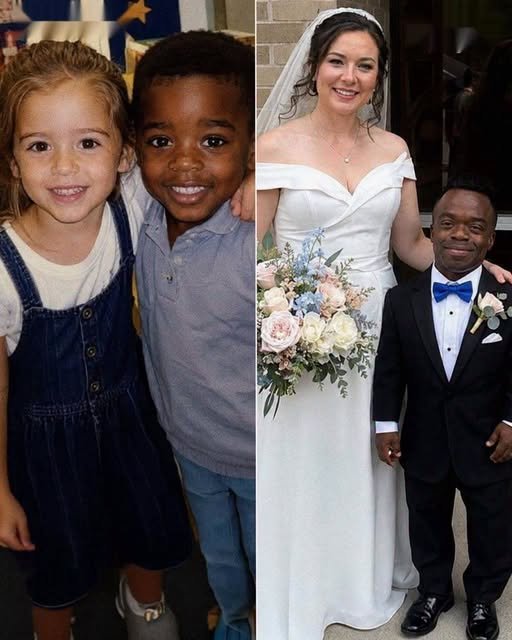
When Noah and I were six years old, we sat beneath the monkey bars and wrote what felt like the most important contract in the world. In purple crayon, on a page torn from my spelling notebook, we promised that if we were both still single at thirty, we would marry each other. Noah immediately pointed out that I had misspelled “promise” as “promiss,” but he signed it anyway. We sealed the deal with two plastic toy rings from a grocery store vending machine and a pinky swear before running back to class, convinced that turning thirty meant being practically ancient.
Life had very different plans.
At eight years old, Noah stopped growing. After years of medical tests, doctors diagnosed him with an extremely rare growth disorder that prevented his body from developing normally. His intelligence, personality, and ambitions flourished, but physically he remained the size of a young child. As we grew older, strangers assumed he was much younger than he was. Some spoke to him like a child. Others pitied him before they even learned his name.
What they never saw was the man I knew.
Noah was the smartest person in every room. He taught himself programming, repaired electronics for fun, debated politics with professors, and possessed a sharp sense of humor that could make anyone laugh. Yet no amount of intelligence could shield him from constant judgment. Dating became nearly impossible because too many people saw only his appearance instead of the confident, capable man standing in front of them.
Despite everything, our friendship never disappeared.
We drifted naturally as adulthood arrived. I left for college while Noah earned his computer science degree online and built a successful career in software development. We still talked, though less often than before. I eventually became engaged to another man named Evan, and Noah congratulated me without mentioning the childish marriage pact either of us had nearly forgotten.
Then everything changed.
Just weeks before my wedding, I was struck by a car while crossing the street. My injuries were severe—a shattered pelvis, a broken leg, and lasting nerve damage that left my future uncertain. As I struggled through surgeries and rehabilitation, Evan slowly disappeared from my life. After only two hospital visits, he ended our engagement over the phone, admitting he wasn’t prepared for the possibility that I might never fully recover.
Noah, however, showed up the very next morning.
He never made dramatic speeches or criticized Evan. Instead, he quietly became the person who helped rebuild my life. He rearranged his work schedule around my therapy appointments, modified his specially adapted car so it could safely transport me, installed accessibility equipment throughout my apartment, cooked meals, and patiently learned exactly when I needed help—and when I simply needed someone to sit beside me in silence.
One evening, after I fell trying to reach the shower, I broke down and called myself a burden.
Noah immediately stopped me.
“You are injured,” he said gently. “That is not the same as being a burden.”
Those words changed something inside me. For years I had defended Noah against people who judged him because of his body, yet after my own accident I had begun measuring my worth by how independent I remained. Noah understood that pain better than anyone because he had lived with it his entire life.
Months later, after I finally managed to walk across the rehabilitation room without assistance, Noah reached into his jacket pocket and unfolded a faded piece of paper. It was our childhood marriage pact, still covered in purple crayon after twenty-three years.
Then he confessed what neither of us had ever dared to say aloud.
“I love you,” he admitted. “But I don’t want gratitude mistaken for love. I don’t want you choosing me because you feel obligated.”
Only then did I realize that what I felt wasn’t gratitude at all. Gratitude couldn’t explain why his laughter brightened my worst days, why I recognized his footsteps before anyone else’s, or why imagining him with someone else hurt more than my injuries ever had.
Our friendship slowly became love.
We dated carefully, determined not to lose what we had built over decades. We learned that love wasn’t about rescuing each other but about respecting each other’s independence while accepting care when it was freely given.
Eventually, Noah proposed.
Not everyone celebrated.
Some relatives questioned whether I truly loved him or simply felt indebted because he had cared for me after my accident. My mother’s objections were even harsher. She insisted I was sacrificing my future and bluntly admitted that Noah “looked like a child.” Although she whispered those words in private, Noah overheard every one of them.
Those comments planted seeds of doubt that grew stronger as our wedding approached.
On the morning of the ceremony, Noah locked himself inside the dressing room. When I finally entered, I found him sitting on the floor holding our faded purple-crayon contract.
“I release you from this promise,” he whispered. “You don’t have to spend your life carrying me.”
It was the most heartbreaking moment of our relationship.
He genuinely believed everyone else might be right—that one day I would regret choosing him. He feared our childhood promise had somehow trapped me into a future built on obligation instead of love.
I knelt beside him and finally told him the truth.
I hadn’t fallen in love because he rescued me after the accident. I had fallen in love because, unlike everyone else, he never treated me as someone broken. He respected my choices, stood beside me during my darkest moments, and reminded me that needing help never made a person less worthy.
When we finally walked into the ceremony together, I addressed every guest before the wedding began.
“Noah is not my charity project,” I said. “He is not a child, and he is not a promise I feel obligated to keep. I am marrying him because I love him. Anyone who believes otherwise is free to leave.”
No one argued.
When the rings were presented, Noah smiled and revealed one final surprise. Beneath our wedding bands rested the two tiny plastic rings we had exchanged as children all those years before—the scratched purple gem and the crooked silver star preserved for twenty-three years.
Those little rings represented more than a childhood promise.
They reminded us that genuine love isn’t built on appearances, obligation, or pity. It’s built on years of trust, respect, laughter, and choosing each other freely—even after life changes in ways neither person could ever predict.