He had survived the confusion of adolescence, the loneliness that settled over our home, and the unbearable absence of his older sister. He had studied through sleepless nights, worked part-time jobs, and carried responsibilities no child should ever have been forced to carry.
Now he was graduating.
For once, I wanted to sit in an auditorium and cry tears of pride instead of grief.
I had no idea that before the ceremony ended, my son would walk onto the stage holding a newborn baby and the hand of my fifty-eight-year-old best friend.
And what he revealed into that microphone would tear open a wound I had carried for ten years.
The Empty Chair in Our Family
The auditorium was packed with families waving programs, adjusting cameras, and calling out to graduates they could barely see.
I sat near the center aisle with my purse balanced on my knees.
The room was warm, but my hands felt cold.
Graduations have a way of forcing you to measure time.
As I watched young people in caps and gowns gather near the stage, I could not stop thinking about how much had changed in ten years.
Ten years earlier, my teenage daughter had walked into the woods behind our neighborhood.
She never came back.
The night before she disappeared, we had argued more fiercely than we ever had before.
She had been dating a boy for only six months, but she insisted they were in love. She wanted my legal permission to marry him.
I thought she was throwing away her future.
“You’re too young to understand what marriage means,” I told her.
“You don’t know him the way I do,” she shouted.
“I know you,” I replied. “And I know you’re not ready.”
Her face hardened.
“You don’t want me to be happy.”
“That isn’t true.”
“It is! You want to control everything!”
She stormed away before dinner, slamming the door so hard that a framed photograph shook on the wall.
At first, I assumed she had gone to see the boy.
An hour later, I called his parents. I expected to find her sitting in their living room, angry but safe. I imagined the adults gathering around the kitchen table and calmly explaining why marriage at that age was a terrible idea.
But she was not there.
The boy said he had not seen her.
I accused him of lying.
The police checked his phone records, spoke with his family, and questioned neighbors. Nothing suggested he knew where she had gone.
Her friends knew nothing either.
By sunrise, search teams were entering the woods.
Marcus had been the last person in our family to see her.
He was still a child then. He had watched his sister disappear between the trees, furious with the entire world.
For years, he blamed himself for not following her.
And for years, I wondered whether my final words had driven my daughter away forever.
The Friend Who Held Us Together
My best friend, Dana, became the person who kept Marcus and me alive.
We had known each other for three decades. She had been beside me through birthdays, holidays, breakups, illnesses, and every ordinary moment that turns friendship into family.
After my daughter disappeared, Dana became the solid ground beneath my feet.
She drove with me along back roads until we knew every abandoned building, gas station, and bus stop within a hundred miles.
Whenever a stranger called claiming to have seen a girl who resembled my daughter, Dana came with me.
Most of the calls led nowhere.
Some were cruel pranks.
Others came from well-meaning people who had simply mistaken someone else for her.
Each false lead broke me a little more.
Dana was always there afterward.
“Please eat something,” she would say, placing soup in front of me. “Marcus is watching you. He needs to know you’re still here.”
When I forgot to pack his lunch, she packed it.
When I could not get out of bed, she drove him to school.
When the phone rang after midnight, she answered it because I had begun trembling whenever I heard the sound.
She attended parent meetings, birthdays, and school performances.
Marcus adored her.
So did I.
There were moments when I genuinely believed Dana had saved our lives.
That belief made what happened later almost impossible to accept.
The Distance I Refused to Question
About a year before graduation, something began to change.
Marcus started leaving the house more often.
“I’m going to the coffee shop,” he would say, sliding his laptop into his backpack. “I have a big exam coming up.”
“Again?” I once asked. “You’ve gone there almost every night this week.”
“It’s easier to focus there.”
His answer sounded reasonable.
He was an adult now. I knew I could not question every decision he made.
Still, there was something in his expression—a tension around his eyes, a hesitation before he left—that unsettled me.
Around the same time, Dana began withdrawing too.
She stopped arriving without warning.
For years, she had walked into my kitchen as if it were her own, calling my name and helping herself to coffee. Suddenly, days passed without a visit.
Sometimes she ignored my calls.
When she eventually responded, she blamed exhaustion, headaches, or appointments.
I tried not to take it personally.
I told myself Marcus was building a life of his own and Dana was simply growing older. Perhaps both of them were finally dealing with the grief they had postponed while taking care of me.
But deep down, I sensed a connection.
The two people closest to me were becoming secretive at exactly the same time.
I did not have the courage to confront them.
I had already spent years chasing answers that never came. I could not bear the possibility of losing anyone else.
So I accepted their excuses.
I convinced myself that silence was safer than truth.
Marcus’s Name Was Called
The lights dimmed, pulling me back into the graduation ceremony.
The principal approached the microphone and welcomed the families. Speeches were given about perseverance, courage, and the future.
Then the graduates began crossing the stage.
One name after another echoed through the auditorium.
Families cheered.
Cameras flashed.
I sat straighter as Marcus’s turn approached.
My heart swelled with pride.
I thought about the frightened little boy he had once been—the child who used to sit by the window, convinced his sister would return if he watched long enough.
Now he was about to walk into adulthood.
When the announcer called his name, I lifted my hands to applaud.
Then Marcus stepped into the light.
But he was not alone.
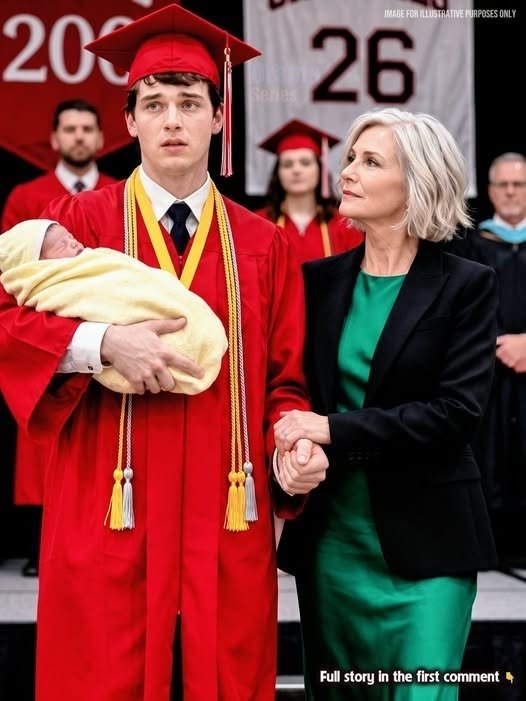
He was holding a newborn baby against his chest.
The infant was wrapped in a pale yellow blanket, with only a tiny face visible beneath the folds.
Walking beside Marcus was Dana.
She was holding his free hand.
The applause around me weakened into confused murmurs.
My body went rigid.
Dana’s silver-streaked hair reflected the stage lights. Tears ran openly down her face as she stood beside my son.
Marcus held her hand tightly while cradling the baby with surprising confidence.
My mind seized upon the most horrifying explanation.
Dana was thirty-five years older than Marcus.
She was my closest friend.
She had helped raise him.
Yet there she stood, hand in hand with my son while he carried a newborn.
My stomach twisted.
“No,” I whispered.
The woman beside me glanced over.
“Are you feeling all right?”
“No,” I answered, unable to look away from the stage. “I think my best friend has been taking advantage of my son.”
My shock quickly turned to fury.
How long had this been happening?
Was this why they had both been avoiding me?
Had the coffee shop been a lie?
Had Dana’s illnesses and appointments been excuses to hide a relationship?
Thirty years of friendship collapsed in my mind within seconds.
I gripped my purse so tightly that my fingers hurt.
Then Marcus walked toward the microphone.
“Mom, Please Listen”
The dean stepped aside.
Whatever was happening had clearly not been included in the ceremony schedule.
Marcus adjusted the baby against his shoulder.
The infant made a soft sound, and Marcus gently rocked him without taking his eyes off the audience.
“Before I talk about my degree,” he began, his voice trembling through the speakers, “there is something I need to tell my mother.”
The auditorium became silent.
Marcus scanned the crowd until he found me.
The moment our eyes met, his face nearly crumpled.
“Mom,” he said, “I know what you probably think you’re seeing.”
My purse slipped from my knees and landed on the floor.
Dana lowered her head.
“Please don’t make any decisions yet,” Marcus continued. “Just listen to me.”
I could hear my own pulse.
“This isn’t what it looks like,” he said. “Dana and I are not together. The baby isn’t ours.”
Relief should have come.
Instead, I felt something even darker gathering beneath his words.
“I’ve been keeping something from you for almost a year,” he continued. “I didn’t do it because I wanted to lie to you. I did it because I had to be absolutely certain.”
A year.
A year of late-night study sessions.
A year of Dana disappearing.
A year of unanswered questions.
“Marcus,” I called, half rising from my seat. “Come down here. We can talk privately.”
He shook his head.
“No, Mom. We can’t.”
Several people turned toward me, but I barely noticed.
“If I tell you privately,” Marcus said, “you might think grief has made me confused. You might believe someone pressured me. I need witnesses. And I need Dana to hear everything too.”
Dana lifted her face sharply.
For a moment, she did not look sad.
She looked afraid.