
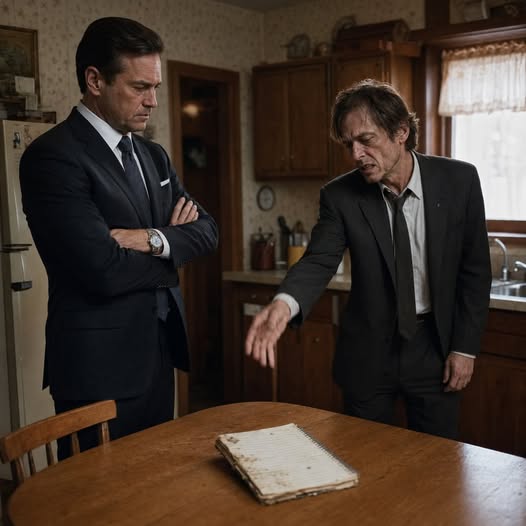
I offered my brother a 60-40 split of our mother’s estate. The cheap, stained notebook he threw at me ruined my life.
“Sell it ‘as-is,’ Dave,” I said, adjusting the cuffs of my custom suit. “The market is hot. You can take 60% since you stayed behind to watch Mom.”
I smiled my best corporate smile, waiting for him to thank me.
We were sitting in our childhood kitchen right after the funeral.
I had flown in from Chicago, leaving my corner office and luxury condo.
Ever since I moved away, I sent a check for $2,000 on the first of every month.
In my head, I was the hero. The provider.
But walking through the old house, I was annoyed.
“Why is the yard dead?” I asked, looking out the window. “I sent money for landscaping. And why was Mom so thin in the casket? Didn’t you buy those expensive protein shakes I ordered online?”
Dave didn’t say a word.
He was wearing a suit that was ten years out of style and drowning his thin frame.
His hands were calloused. He looked a decade older than me, even though he was three years younger.
He slowly stood up, walked to a junk drawer, and pulled out a cheap, spiral-bound notebook.
He tossed it onto the table. It landed with a heavy thud.
“Read it,” he whispered, his voice completely hollow.
It was a care log.
*October 12th:* Mom screamed for six hours straight. She forgot who I am. She bit my arm when I washed her. I’m bleeding, but I can’t afford an ER co-pay, and I can’t leave her alone.
*November 3rd:* The $2,000 Michael sent covered the mortgage, but the insurance agency just denied her new Alzheimer’s medication. They said it isn’t “medically necessary.” I sold my truck today to pay the pharmacy out-of-pocket.
*December 25th:* Mom cried all day. Her ‘successful son’ didn’t call until 8 PM. By then, her sundowning was so bad she couldn’t speak. I ate a cold sandwich on the floor by her bed so she wouldn’t be terrified of the shadows.
*January 15th:* My back gave out lifting her from the toilet. The doctor says I need surgery for a herniated disc. But a private memory care facility costs $9,000 a month, and if I go to the hospital, the state will take her and put her in a Medicaid ward. I took six Advil and kept going.
I closed the notebook. I couldn’t breathe.
Dave looked me dead in the eye.
“You sent two grand a month, Michael. I appreciate it. I do.”
He pointed a shaking finger at my chest.
“But while you were sending checks, you were sleeping eight hours a night.”
“You had weekends off. You took vacations. You built a 401k.”
He slammed his hand on the table.
“I haven’t slept a full night in four years. I lost my fiancée because I could never leave the house. I quit my engineering job so Mom wouldn’t end up strapped to a bed in a chronically understaffed state facility.”
Tears finally welled in his sunken eyes.
“Money doesn’t clean up diarrhea at 3 AM. Money doesn’t fight on the phone with the insurance company for five hours. Money doesn’t hold her while she shakes in terror from hallucinations.”
He turned his back on me.
“Sell the house. Keep all the money. I don’t want a dime. I already paid my share with my life.”
He walked into Mom’s old room and closed the door.
I was left alone in the silent kitchen.
I looked at my luxury watch. I looked at my designer shoes.
Suddenly, I felt entirely worthless.
I paid for her pills, but he crushed them up and coaxed her to swallow them.
I paid for the casket, but he held her hand while she took her last breath.
That afternoon, I drove straight to a local law firm.
I drafted a quitclaim deed transferring 100% of the house to Dave.
I set up a trust to cover his health insurance and living expenses for the next ten years.
It wasn’t a gift. It was back pay.
In American families, there is usually a “Satellite Child” and a “Cane Child.”
The Satellite revolves from a distance. They send money. They visit on holidays to “supervise.”
The Cane stays. They navigate a broken healthcare system. They support the crushing weight of illness until they crack.
A bank transfer does not change an adult diaper. A check does not cure the loneliness of a caregiver watching their own life pass by.