
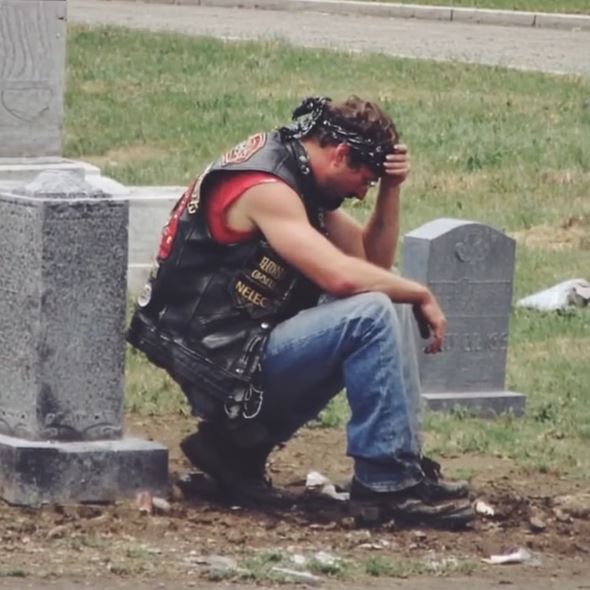
For months, a ritual played out at my wife Sarah’s grave that I couldn’t understand. Every Saturday at two o’clock, a man on a motorcycle would arrive. He was everything my gentle, soft-spoken wife was not—cloaked in leather, covered in tattoos, a figure of quiet intensity. He would sit silently by her headstone for exactly one hour, then leave. I watched from a distance, my grief mingling with confusion and a growing sense of intrusion. Who was this stranger, and what was his connection to the woman I loved?
My curiosity eventually overpowered my hesitation. One Saturday, I approached him as he sat there. He stood up, and I was startled to see tears on his face. He introduced himself as Mike and apologized for intruding. Then he explained that he was there to say thank you. He told me a story about his young daughter, Kaylee, who had been diagnosed with leukemia years ago. The medical bills were crippling, and he was drowning in despair. It was a nurse—my Sarah—who had comforted him. Days later, he discovered that an anonymous donor had paid his daughter’s remaining $40,000 hospital bill.
Mike spent years trying to find the donor. When he finally did, it led him to Sarah’s obituary. He had never gotten the chance to thank her, so he came every week to honor the woman who saved his little girl. As he spoke, a memory surfaced—a long-ago argument Sarah and I had about a large, unexplained withdrawal from our savings. She had insisted it was for “something important,” and I had never fully understood her secrecy until that very moment.
Now, Mike and I meet at the cemetery every Saturday. We share stories about Sarah and the incredible, hidden impact she had on the world. He recently brought his daughter, Kaylee, who is now a healthy teenager. She placed flowers on the grave and thanked Sarah for her life. The stranger I once viewed with suspicion is now a dear friend, a living testament to my wife’s secret generosity. Her kindness created a bond that outlasted her life, teaching me that the most meaningful legacies are often the ones we never see.