
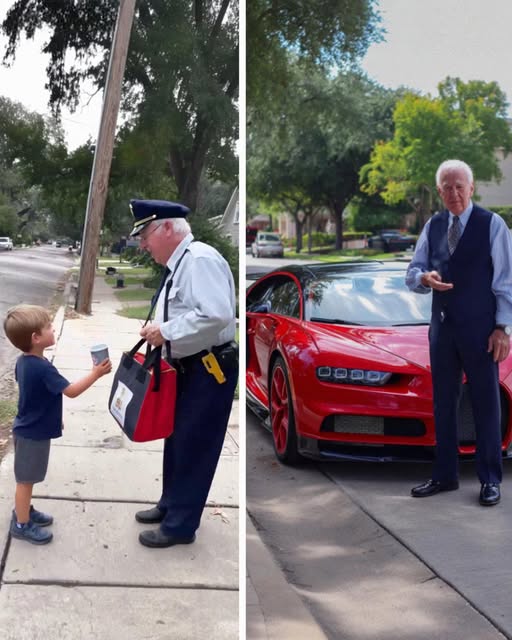
It was a sweltering summer day, the kind that makes the pavement shimmer. My five-year-old son, Eli, was playing on the driveway while I kept watch from the porch. We both noticed the mailman making his rounds, his steps slow and heavy under the oppressive sun. Some of our neighbors watched him with judgmental whispers, but Eli saw only a person who was hot and tired. Without a word, he ran inside and came back with his favorite cup, filled with ice water, and a chocolate bar. “Here, mister,” he said, offering his small gifts. “You look really thirsty.”
The mailman’s reaction was profound. His eyes welled up as he accepted the simple kindness from a child. He thanked Eli and continued on his route, and I thought that was the end of a sweet moment. I was wrong. The next day, as I waited to pick Eli up from preschool, a stunning red Bugatti pulled up to the curb. The driver stepped out, and to my astonishment, it was the mailman. But he wasn’t in uniform; he was dressed in an elegant white suit.
He walked directly to Eli, knelt down, and handed him a small velvet box. Inside was a miniature red Bugatti, a perfect replica of the real car. The man explained that he had once been a mailman before building a very successful company. Every year, he spent one week delivering mail to stay grounded and remember his roots. He told Eli that his simple, heartfelt act of kindness had meant more to him than any business success ever could.
A few days later, we received a letter containing a check for $25,000 for Eli’s future education. But the real value of that hot afternoon wasn’t the money or the fancy car. It was the lesson it imprinted on my son—and on me. True kindness, offered without expectation, is a language that everyone understands. It’s a force that can bridge any divide, and sometimes, its reward is a reminder that goodness is its own greatest fortune.