
Part 2: Forty Minutes
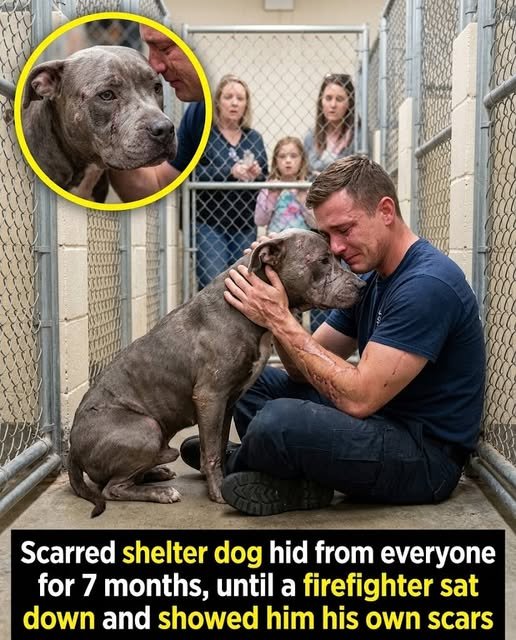
The left side of the man’s head was covered in scars.
They stretched from the top of his scalp, down across the place where his left ear had once been, and continued along the side of his neck before disappearing beneath the collar of his hoodie. The skin was smooth, glossy, and unevenly colored, a mixture of pink and pale patches pulled tight, where no hair would ever grow again. Almost his entire left ear was missing. Only a small, folded remnant of scar tissue remained.
Denise instinctively covered her mouth with her hand before she could stop herself.
The man noticed. His shoulders stiffened. But he didn’t reach for his cap or try to cover his head again.
He simply remained seated on the concrete floor with his back against Kennel 14. He didn’t speak or move. His scarred head hung forward, and his hands rested loosely on his knees.
seat along the side of the room. Her eyes were swollen and red.
“He withdrew his application,” she answered quietly. “This afternoon.”
Harold Gaines gave a solemn nod and picked up his pen.
“In that case, I’ll accept a motion,” he said, “to approve the staff’s recommendation.”
At the far end of the shelter, inside Kennel 14, the gray dog sat beside his gate, gazing down the deserted hallway toward the entrance.
His tail no longer moved.
Part 6: The Door
“I second that motion,” one of the board members said.
“All those in favor?” Harold Gaines asked.
Three hands rose around the table.
Suddenly, the community room door slammed open.
Every person turned toward the entrance.
Mia Chen stepped inside first, wearing her purple coat and struggling to catch her breath. She was pulling someone along by the hand.
Standing behind her in the doorway was Luis Navarro.
His hood was down. His cap was gone. He wasn’t wearing sunglasses.
Under the bright fluorescent lights, his scarred head was completely exposed. His damaged left ear, the taut, glossy skin extending down his neck, every visible mark of the fire—all of it was uncovered in front of a room full of strangers.
Twenty people turned in their folding chairs to stare at him.
Luis’s hands trembled beside his body. His face had turned ashen, and his chest rose and fell rapidly.
But he kept his head up.
“I’m sorry I’m late,” he said, his voice rough and unsteady. “I’m here about Kennel 14.”
Harold Gaines slowly lowered his raised hand.
“She showed up at my door,” Luis explained, gesturing toward Mia. “At six-thirty. She and her mother came over, and she kept knocking until I answered.” He gave a faint, almost disbelieving laugh. “She told me that if Ash could leave his corner for me, then I could leave mine for him.”
The entire room fell silent.
Luis walked toward the front. Each step seemed to require tremendous effort. He stopped before the long folding table, with twenty strangers behind him looking at the scars covering the back of his head.
“My name is Luis Navarro,” he began. “Four years ago, I worked as a firefighter at Station 18. I entered an apartment fire on Cleveland Avenue and carried a five-year-old girl out from beneath her bed.” He glanced over his shoulder at Mia. “That little girl.”
A low murmur spread through the audience.
“The ceiling collapsed on me while I was getting her out,” Luis continued. “These are the injuries it left behind.” He gestured toward his head and neck. “For the next two years, I stayed inside my apartment with the blinds drawn. I couldn’t bear the way people looked at me.”
He drew a trembling breath.
“Last Saturday, I came into this shelter and found a dog sitting in the corner with his face turned toward the wall. He’d learned to do that because of the way people treated him. They made him believe his face frightened them, that he needed to hide it.” His voice cracked. “I understood that dog. I had become that dog myself.”
Harold Gaines placed his pen on the table.
“You have requirements,” Luis continued. “A fenced yard. Experience handling dogs. I understand why those rules exist. I don’t have a yard, and I don’t have much else to offer.” He looked directly at the board members. “But that dog entered a burning shed and shielded three puppies that didn’t belong to him. He allowed the flames to destroy half his face rather than let those puppies get hurt. Then he spent seven months alone in a corner because people couldn’t bear to look at him.”
He swallowed, struggling to steady his voice.
“I did the same thing for a little girl who wasn’t mine. And afterward, I spent two years hiding in my own corner.”
Mia was crying in the front row. Her mother was crying, too. Denise stood nearby with tears running down her cheeks.
“I’m not asking you to hand me a dog,” Luis said softly. “I’m asking you to give us both a chance to stop hiding. Together.”
He remained standing before them, his scarred face uncovered.
Nobody spoke or moved.
Then Mia rose from her folding chair.
“He’s the only person Ash ever came out for,” she said, her voice trembling. “Nobody else. Not once in seven months. I was there. I watched it happen.”
She raised her left hand so everyone could see the small pink scar.
“And he’s the only person who ever carried me out of a fire,” she added.
Harold Gaines studied the little girl’s hand for a long moment. Then he looked at the firefighter standing before him.
He removed his reading glasses.
“Ms. Howell,” he asked quietly, “does our program allow a foster-to-adopt placement under staff supervision while Mr. Navarro works toward meeting the housing requirements?”
Denise wiped her tears away. “Yes, sir. We can arrange that.”
“I’m withdrawing my vote,” Harold announced. “I move that Mr. Navarro be approved as a foster-to-adopt placement for Kennel 14, effective tonight.”
“I second the motion,” the board member beside him said.
“All those in favor?”
Every hand around the table went up.
Twenty strangers rose from their folding chairs and began applauding.
Luis Navarro stood at the front of the room, his scarred face uncovered and wet with tears. For the first time in four years, he looked directly at the people around him without turning away.
Denise returned from the back of the shelter with Ash on a leash.
The gray dog entered a room filled with people and immediately stopped, startled by the crowd.
Then he spotted Luis.
He hurried across the room in three quick strides, his tail spinning wildly, and pressed his scarred face against Luis’s scarred neck in front of everyone.
Neither of them tried to hide.
Later that evening, Luis sat on the shelter steps with Ash’s head resting in his lap. He finally shared something with Mia and her mother that he had never told another person.
“The Thursday before I ever came to this shelter, I’d already written my resignation letter to the fire department,” he admitted quietly. “I planned to mail it on Monday. Walk away for good. Move somewhere nobody knew who I was. Keep the blinds shut for the rest of my life.”
He lowered his eyes toward the dog.
“Everyone will probably say I rescued him,” Luis said. “But he was the one who found the courage to leave his corner first.”
Part 7: Partner
Luis gave him the name Partner.
That was what firefighters called one another. The person who entered the danger zone beside you. The person you never abandoned.
When the rescue’s donors learned their story, they responded. A retired contractor built a six-foot fence around the small yard of a rental house Luis located two weeks later. He did the work without charging a penny. Luis passed the home inspection, and in December, the adoption became official.
Every morning at seven, Luis and Partner walk the same loop around Schiller Park in German Village.
No hood. No cap. No sunglasses.
People still glance at them occasionally. Some continue to stare. But Luis no longer lowers his head, and Partner doesn’t turn his face away either. They simply carry on walking, two scarred faces held high, moving side by side.
In January, Luis contacted the Columbus Division of Fire and asked whether the public education position they had offered him for three years was still available.
They gave him the job the following day.
Today, twice every week, Luis Navarro visits elementary school gymnasiums throughout Columbus for fire safety programs, dressed in his formal uniform. Partner accompanies him, wearing a little red vest bearing the fire department’s name.
The children always fall silent when the pair enter the room.
Luis waits until everyone has settled down. Then he kneels beside the gray dog, whose ears are gone and whose face bears the marks of severe burns, and removes his cap.
And every time, he begins by telling the children the same thing:
“Scars don’t make anyone ugly. They’re simply proof of what someone has survived.”
Afterward, he allows the children to approach one at a time and gently stroke Partner’s fur.
The dog who once spent seven months hiding with his face against a cinderblock wall now sits in the center of a school gymnasium. His face is lifted, his eyes remain open, and his tail sweeps across the polished wooden floor as a long line of second graders reach out their little hands to touch the scars on his face.
Not once does he turn away from them.
Mia joins them whenever she can. She stands beside Luis and Partner at the front of the room, raising her left hand with its small pink scar so the children can see that one, too.
Three faces. Three scars. No one hiding anymore.
Whenever reporters ask Luis how everything began, he gives them the same answer.
He spent a long time sniffing the scar on my neck before gently licking it. I hadn’t appeared in public for two years because I was terrified of people staring at my face. It turned out that all I needed was someone who had survived the fire, too—someone who could look at me without fear.
If this story touched your heart, follow our page for more stories that remind us why dogs are among the best of us. 
Website Disclaimer
The information provided on this website is for general informational and educational purposes only. While we strive to ensure that all content is accurate and up to date, we make no guarantees regarding the completeness, reliability, or accuracy of any information published.
The views and opinions expressed in articles belong to their respective authors and do not necessarily reflect the views of this website. Any action you take based on the information found on this website is strictly at your own risk. We will not be liable for any losses, damages, or inconveniences arising from the use of our content.
Some articles may contain opinions, third-party information, or external links. We do not endorse or guarantee the accuracy of content on external websites and are not responsible for their practices or policies.
All content on this website is provided in good faith and is intended for informational purposes only. Readers are encouraged to verify information independently and seek professional advice where appropriate.