
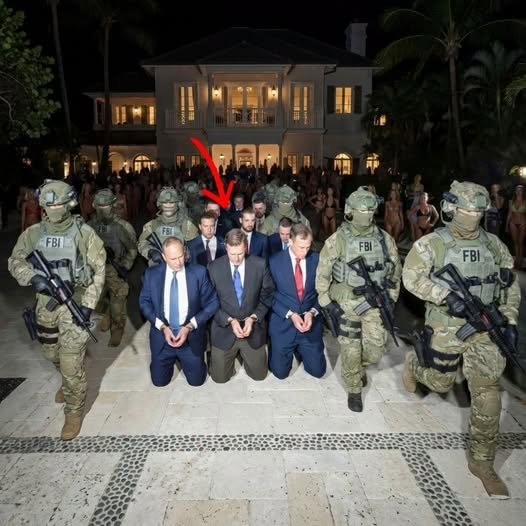
As investigators dug deeper, the case became more complicated than anyone had anticipated. The suspected estate appeared to have been designed to withstand scrutiny, with restricted airspace, private security teams, and communication systems that made outside surveillance difficult. Every lead raised new questions. Who had financed the operation? How many people might have been held there? And, most importantly, was Katia the only person who had managed to escape?
According to her account, the island’s greatest weapon was not its advanced technology but its isolation. Dense vegetation concealed pathways, steep cliffs limited access, and unpredictable weather made escape by sea extremely dangerous. Katia claimed that the captives had been deliberately separated from one another, leaving them frightened, disoriented, and uncertain about whom they could trust. She said she had spent days studying the guards’ routines, waiting for a moment when the storm might create enough confusion to give her a chance.
When the storm finally struck, Katia seized her opportunity. She described running through thick undergrowth while alarms sounded behind her. Injured and exhausted, she eventually reached the shoreline, where she found an overturned kayak. The journey across the rough water nearly cost her life, but she continued until fishermen spotted her struggling in the distance. By the time rescuers brought her ashore, she was suffering from exposure, blood loss, and severe exhaustion.
Medical professionals focused first on stabilizing her condition. Investigators then began collecting forensic evidence, documenting her injuries, preserving her clothing, and examining the circumstances surrounding her escape. Her account provided a starting point, but authorities understood that extraordinary allegations required independent corroboration. Satellite imagery, financial records, witness interviews, and physical evidence would all need to be carefully examined before conclusions could be reached.
The photograph Katia had identified also became a sensitive part of the investigation. Authorities would need to establish whether the person pictured had any connection to the alleged crimes rather than relying solely on an identification made under traumatic circumstances. A public figure’s appearance in a photograph, by itself, would not establish guilt. Investigators would have to verify identities, locations, communications, and any evidence linking specific individuals to criminal activity.
Meanwhile, the possibility that other victims might still be in danger made the investigation especially urgent. Specialists in missing-person cases and human trafficking would need to determine whether any reports of unexplained disappearances were connected to the suspected location. If credible evidence supported the allegations, a carefully coordinated rescue operation could be necessary to protect potential victims while preserving evidence for prosecution.
For Katia, the road to recovery would be difficult even if the investigation eventually brought those responsible to justice. Surviving captivity and a violent escape could leave lasting physical and psychological scars. Investigators and medical professionals would need to protect her privacy, provide appropriate support, and avoid exposing her to unnecessary pressure while she recounted what had happened.
Yet one question remained at the heart of the case: If Katia’s allegations were true, how could an operation of such scale have remained hidden for so long?
The answer would depend on evidence, not speculation. Until investigators verified the claims and established who, if anyone, was responsible, the alleged island hunting operation remained an unproven account rather than an established criminal case.
Katia’s reported escape, however, raised a chilling possibility that authorities could not afford to ignore: somewhere beyond the familiar boundaries of public view, vulnerable people might be waiting for someone to discover the truth.
Important note: The account provided does not identify verifiable evidence or confirmed reporting establishing that Katia, the alleged island, or the described investigation are real. The continuation above therefore treats the allegations as unverified rather than presenting them as confirmed news.
Website Disclaimer
The information provided on this website is for general informational and educational purposes only. While we strive to ensure that all content is accurate and up to date, we make no guarantees regarding the completeness, reliability, or accuracy of any information published.
The views and opinions expressed in articles belong to their respective authors and do not necessarily reflect the views of this website. Any action you take based on the information found on this website is strictly at your own risk. We will not be liable for any losses, damages, or inconveniences arising from the use of our content.
Some articles may contain opinions, third-party information, or external links. We do not endorse or guarantee the accuracy of content on external websites and are not responsible for their practices or policies.
All content on this website is provided in good faith and is intended for informational purposes only. Readers are encouraged to verify information independently and seek professional advice where appropriate.