
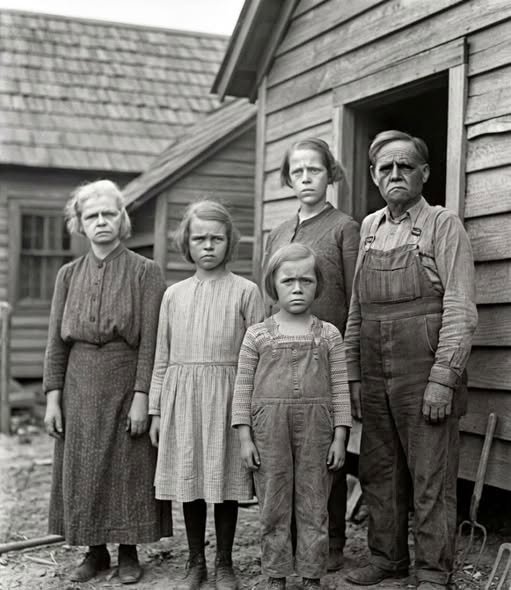
In the summer of 1976, a discovery deep in the backwoods of eastern Kentucky became the beginning of a mystery that, according to the story, would haunt everyone who came into contact with it.
Three children were reportedly found living inside a root cellar beneath an isolated property belonging to a family known locally as the Fowlers. They had no birth certificates, no school records, no known medical histories, and no photographs that could establish where they had come from.
But it was not their isolation that supposedly alarmed investigators most.
It was what happened after officials collected blood samples.
The laboratory results allegedly contained an unusual notation suggesting that the samples did not fit the genetic profiles the investigators expected. Within days, rumors began circulating that the findings had been classified, the children had been separated, and the people who knew the most about the case had been warned to remain silent.
Then the Fowler property reportedly burned to the ground.
For the people who lived nearby, the disappearance of the old farmhouse only deepened a mystery that had surrounded the Fowler family for generations.
Was there really something unusual about the children, or had a tragic case of isolation and neglect become distorted into something far more sinister?
The answer, if one existed, would have to begin with the family itself.
A Family Nobody Wanted to Talk About
The Fowler clan had supposedly lived in the mountains of eastern Kentucky for generations.
Their property stood far from the nearest main road, surrounded by thick woodland, steep hills, and narrow paths that became nearly impassable after heavy rain. The closest town, described in this fictional account as Harland, lay approximately seventeen miles away.
For much of the year, reaching the property required patience and a reliable vehicle. During the wettest months, even those precautions were not always enough.
The Fowlers rarely appeared in town.
They did not attend community gatherings, establish close relationships with their neighbors, or participate in the ordinary routines that connected other families in the region.
Children who grew up in Harland supposedly learned about the Fowlers through warnings passed down by their parents.
Don’t wander onto their land.
Don’t knock on their door.
And if you ever see someone from that family on the road, mind your own business.
Nobody seemed to know exactly why the warnings existed.
Some residents claimed the family simply preferred solitude. Others whispered about old disputes, strange nighttime noises, and lights appearing between the trees long after the rest of the mountain had gone dark.
Over time, ordinary uncertainty transformed into local folklore.
Trace Family Roots
The Fowlers became the kind of family people discussed in lowered voices, not because anyone could prove wrongdoing, but because nobody could explain what happened behind their closed doors.
Then, in the summer of 1976, a social worker named Margaret Vance reportedly decided that the rumors could no longer be ignored.
The Social Worker Who Followed the Rumors
She understood that poverty, isolation, and distrust of government authorities could make it difficult for outsiders to understand what was happening inside a household. She had also learned that unusual circumstances did not automatically indicate abuse or criminal activity.
But some reports were difficult to dismiss.
According to the story, Vance had received several informal accounts suggesting that children were living on the Fowler property without attending school or receiving medical care.
Nobody could provide their names.
Nobody could explain their ages with certainty.
And nobody appeared to know when the children had first arrived.
At first, Vance allegedly attempted to gather information through ordinary channels. She made inquiries, spoke with residents, and tried to determine whether the family had ever interacted with local schools or medical facilities.
The answers were frustratingly incomplete.
No one remembered seeing the children in town. No teacher could identify them. No neighbor could recall a birth announcement or a family celebration.
Eventually, Vance made her way toward the property.
The journey took her beyond the familiar roads and into a landscape where the trees crowded close to the path. The farther she traveled, the quieter the surroundings became.
There were no passing vehicles, no nearby houses, and no obvious signs of recent activity.
When she finally reached the Fowler property, she found an aging farmhouse surrounded by overgrown vegetation.
The windows were dark.
The yard appeared neglected.
And somewhere beneath the house, according to the account, three children were waiting to be discovered.
The Root Cellar Beneath the House
The cellar was reportedly hidden beneath a section of the property that looked ordinary from the outside.
Root cellars were common in rural communities, traditionally used to store vegetables and preserve food through the winter. But the space described in this story was allegedly being used for something very different.
The entrance led downward into a cramped underground chamber.
The air was damp. The walls were cold, and the smell of wet soil lingered in the darkness.
Inside, investigators supposedly found three children.
They appeared frightened and unfamiliar with ordinary interactions outside their immediate surroundings. Their clothing was worn, and their understanding of the world beyond the property seemed limited.
The children did not offer clear explanations about who they were or how long they had lived there.
When asked about their parents, they reportedly gave incomplete answers.
When asked their names, their responses allegedly confused the investigators even further.
The most unsettling detail was not that the children behaved strangely. Children raised in extreme isolation can develop significant difficulties with language, social interaction, and their understanding of unfamiliar environments.
It was that, according to the story, officials could find no reliable records establishing their identities.
No birth certificates.
No school enrollment documents.
No medical files.
Nothing that immediately connected the children to a recognizable family history.
The discovery raised urgent questions.
Who had been caring for them? Why had they been kept away from the outside world? And how had three children remained unknown to the authorities for so long?
Those questions alone would have justified a serious investigation.
But the story takes a darker turn when the children were allegedly taken for medical examinations.
The Blood Samples That Changed Everything
Following the discovery, the children were reportedly placed under the supervision of state officials and examined by medical personnel.
Blood samples were collected as part of the effort to establish their identities and understand their medical histories.
At this point, the narrative introduces the claim that would eventually turn the Fowler case into an enduring mystery.
The laboratory results allegedly contained a notation describing genetic markers as inconsistent with known human populations.
According to the story, the wording immediately attracted attention.
A laboratory technician who had processed the samples supposedly left her position two days later. She never publicly explained why.
Rumors then spread that the findings had been sealed, preventing anyone outside a small circle of officials from examining the results.
But what would such a laboratory finding actually mean?
In real genetic science, DNA testing does not produce a scientifically meaningful conclusion that a person is simply “not human” because their genetic markers differ from familiar populations.
Human genetic variation is extensive. Differences can reflect ancestry, rare mutations, unusual combinations of inherited variants, sample contamination, technical errors, or limitations in the methods used to analyze a specimen.
A genuinely unusual result would require repeat testing, independent laboratory analysis, careful examination of the samples, and documentation of the methods used.
It would not, by itself, establish that a person belonged to an unknown species.
That distinction is crucial.
The alleged laboratory notation is the central mystery of the Fowler story, but no verifiable laboratory report has been provided to establish that the test occurred or that the quoted finding was ever recorded.
Without the original documentation, the claim remains part of the narrative rather than a confirmed scientific discovery.
Still, within the fictional account, the supposed result changes the way officials view the children.
What began as an investigation into three unidentified minors becomes something that seems to reach beyond the original questions.
And the more mysterious the results appear, the more difficult it becomes to separate evidence from speculation.
Three Children, Three Different Destinations
The story claims that the children were eventually separated.
Each was reportedly transferred to a different facility, making it more difficult for them to communicate with one another or preserve a shared account of their lives.
For investigators, separating children can sometimes be necessary when individual medical needs, safeguarding concerns, or placement requirements demand different arrangements.
But separation can also be deeply distressing, particularly for children who have depended on one another for safety and familiarity.
In the Fowler narrative, the decision becomes another source of unanswered questions.
Were the children separated because of ordinary child-protection procedures? Was their placement determined by medical concerns? Or did officials believe that keeping them together would complicate the investigation?
The story offers no independently verifiable answer.
Instead, it suggests that records became increasingly difficult to locate as the months passed.
Names were allegedly changed or incompletely recorded. Reports disappeared into administrative files. Requests for information produced conflicting explanations.
The result was a growing impression that the case was being buried.
Yet missing paperwork does not automatically demonstrate a deliberate cover-up. Historical records can be incomplete for many reasons, especially when cases involve children, fragmented local administration, or outdated filing systems.
To establish intentional suppression, investigators would need evidence showing that records existed and were deliberately withheld, destroyed, or altered.
That evidence is absent from the account presented here.
Nevertheless, the possibility of a mystery left unresolved remains central to the story.
The children had been found.
They had been removed from the property.
And the people who might have explained their origins were no longer readily available to answer questions.