
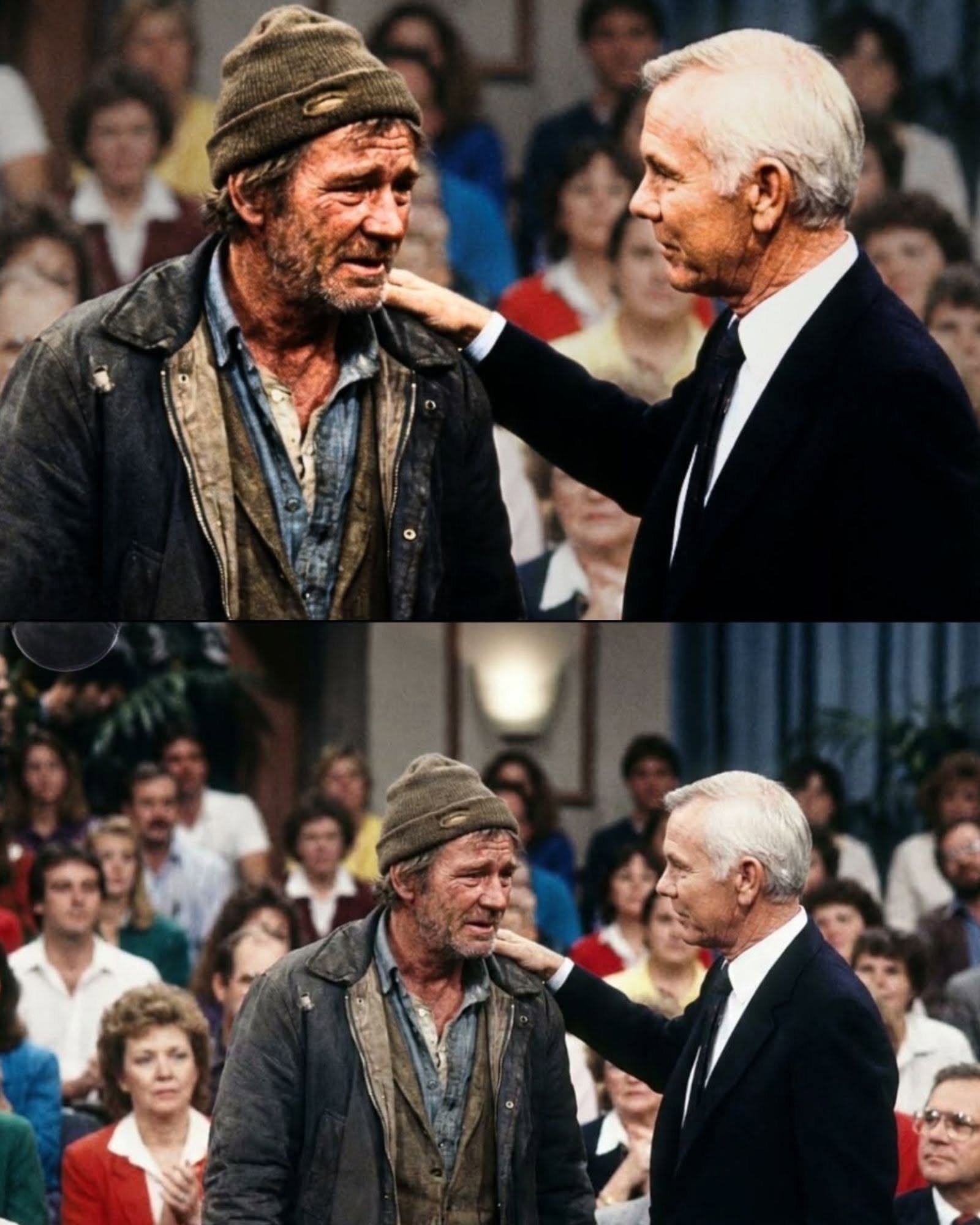
For more than two decades, Johnny Carson had mastered the rhythm of late-night television.
He knew exactly when to deliver a joke.TV & Video
He knew when to pause for laughter.
He knew how to make a room full of people feel comfortable with just a smile.
Every night, millions of viewers welcomed him into their homes through the familiar world of The Tonight Show. The stage lights, the orchestra, Ed McMahon’s introduction, and Carson’s calm sense of humor had become part of American television history.
But one fictionalized story imagines a night when the routine completely changed.
It was supposed to be another ordinary episode.
The audience was ready.
The cameras were rolling.
The jokes were prepared.
Then Johnny Carson looked toward the audience and noticed someone sitting quietly in row seven.
A man who looked completely out of place.
His clothes were worn.
His shoes appeared damaged.
His face showed years of hardship.
To most people in the room, he was just another audience member.
But according to the story, Carson recognized him instantly.
And in that moment, the famous entertainer was no longer thinking about ratings, jokes, or television.
He was remembering the past.
A Face From Decades Earlier
The story describes the man as Tommy Reynolds, someone Carson had known long before fame and television changed his life.
According to the fictional account, Reynolds was not always living on the streets.
Decades earlier, during wartime, he was remembered as a brave person who helped others during a dangerous moment.
The story claims that he once saved Carson’s life during a military accident, pulling him away from danger and helping others survive.
Whether viewed as a literal event or a symbolic story, the meaning behind it is powerful:
Sometimes the people who make the biggest difference in our lives are not the ones who become famous.
They are ordinary people who show courage when it matters most.
Years may pass.
Lives may change.
People may lose contact.
But acts of kindness can remain unforgettable.
The Man Behind the Famous Smile
Johnny Carson was known to the public as a comedian.
A television host.
A master of conversation.
But behind the cameras, stories about Carson often focused on a quieter personality — someone who valued privacy and personal connections.
The fictional scene works because it shows a different side of a person audiences usually saw only through entertainment.
On television, Carson made millions laugh.
But in this story, his attention was not focused on making people laugh.
It was focused on remembering someone who had once helped him.
The contrast creates the emotional heart of the narrative.
A man known by millions suddenly stops everything for someone almost nobody noticed.
The spotlight moves away from the celebrity.
And toward the person sitting quietly in the audience.
The Moment the Show Stopped
According to the story, Carson interrupted his normal performance.
The jokes stopped.
The audience became confused.
The cameras continued recording as the host looked toward the man in the crowd.
Instead of continuing the program, Carson walked away from the expected script.
It was a moment that represented something rare in entertainment:
A human reaction stronger than the show itself.
Television is built around schedules.
Segments.
Timing.
Commercial breaks.
Everything is carefully planned.
But sometimes real emotions break through the structure.
A person recognizes another person.
A memory returns.
A forgotten connection comes back to life.
And suddenly, the planned program no longer feels important.
Why Stories Like This Connect With People
Stories about unexpected kindness often become popular because they touch something universal.
Everyone has experienced moments when someone’s actions made a difference.
A stranger who offered help.
A teacher who believed in them.
A friend who stayed during difficult times.
A person who showed compassion when it was needed most.
The reason these stories stay with people is because they remind us that small actions can have long-lasting effects.
The person who helps today may never realize how important that moment becomes years later.
The person receiving kindness may carry that memory forever.
That idea is at the center of this story.
A forgotten hero.
A grateful friend.
A moment when the past returned.
The Difference Between Fame and True Impact
One of the strongest themes in the story is the contrast between public recognition and personal importance.
Johnny Carson became one of the most recognizable entertainers in America.
Millions knew his name.
Millions watched his show.
But the fictional story suggests that Carson did not measure people by fame.
He remembered character.
He remembered courage.
He remembered kindness.
The man sitting in the audience was not introduced as a celebrity.
He was not surrounded by attention.
He was simply someone who had once made a difference.
And that was enough.
A Reminder That Everyone Has a Story
The most powerful part of stories like this is the reminder that appearances do not reveal everything.
A person sitting quietly in a crowd may have lived an extraordinary life.
Someone struggling today may have once helped countless others.
Someone overlooked by society may have once been someone’s greatest hope.
The audience in the story saw only an older man wearing worn clothing.
Carson saw a person with a history.
That difference changes everything.
It asks an important question:
How many remarkable stories exist around us that we never hear?
The Emotional Lesson Behind the Story
At its core, this story is not really about television.
It is about gratitude.
It is about remembering.
It is about recognizing people who helped us along the way.
Success can sometimes make people forget where they came from.
Busy lives can make people lose touch with important relationships.
Years can pass without a single conversation.
But meaningful moments do not disappear.
They remain part of who we become.
The fictional encounter between Carson and Reynolds represents the idea that gratitude has no expiration date.
A thank-you given decades later can still matter.
A forgotten person can still deserve recognition.
A single moment of compassion can still change a life.
The Legacy of a Simple Human Connection
The greatest stories are often not about wealth, fame, or achievements.
They are about relationships.
They are about moments when people choose to care.
The imagined scene of Johnny Carson stopping his show captures a powerful idea:
Even the biggest stages in the world can become small when one human being recognizes another.
The cameras, the audience, and the entertainment all become secondary.
What remains is a simple truth:
People remember how others made them feel.
They remember kindness.
They remember courage.
They remember those who stood beside them when it mattered.
And sometimes, many years later, those memories find their way back into the light.
Because behind every famous person is a personal story.
Behind every stranger is a hidden history.
And behind every act of kindness is the possibility that someone, somewhere, will never forget.