
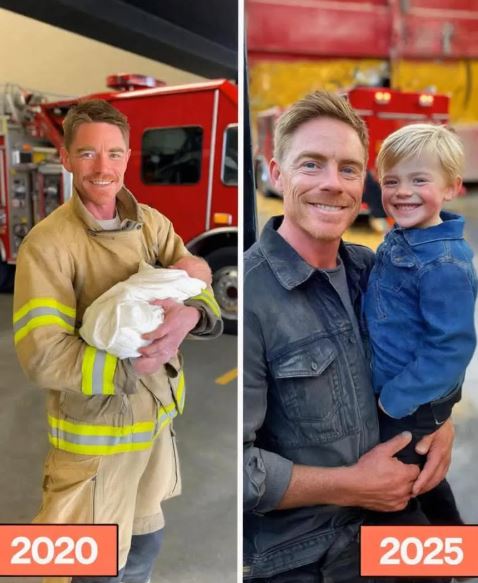
My life was defined by the roar of fires and the rhythm of emergency calls, but the most profound moment of my career was a quiet one. It was the night I discovered a newborn baby, left in a basket by the door of Fire Station #14. The wind almost drowned out his faint cries. I picked him up, and his tiny hand wrapped around my finger, a gesture of pure trust that sealed my heart. I knew in that instant that he was my son. I named him Leo, and the adoption process felt less like a choice and more like a destiny we were both meant for. Our life together was built on a foundation of simple joys—bedtime stories, messy art projects, and a love that filled every corner of our home. For five beautiful years, it was just the two of us, a perfect, unbreakable team.
That illusion of simplicity shattered one ordinary evening with a knock at the door. Leo and I were in the middle of a grand cardboard castle construction when the sound echoed through the house. I opened it to find a woman standing there, her face etched with a pain I could feel from the doorstep. Her voice was barely a whisper as she said, “You have to give my child back.” Her name was Emily, and she claimed to be Leo’s birth mother. My world tilted on its axis. Every protective instinct screamed at me to shut the door and hold my son tighter, but the raw desperation in her eyes held me captive.
She wasn’t there to make demands or cause a scene. Emily shared her story with a heartbreaking honesty—of being young, terrified, and with nowhere to go, she had made the agonizing decision to leave her baby in a place she knew he would be found and kept safe. She believed it was the only way to give him a chance at a life she couldn’t provide. She didn’t ask to take him away; she only asked for a chance to see him, to know that he was happy and loved. It was a plea I couldn’t easily dismiss, no matter how much I wanted to.
What followed was a slow, delicate dance of trust. Emily began to appear at the edges of Leo’s life—standing at the back of a school play, watching from a distance at the park. Leo, with the open heart of a child, started to notice the “nice lady” who always smiled at him. Guided by a love for him that was bigger than my own fear, I began to allow her closer. We started with brief visits, then shared outings. The walls of mistrust and anger I had built began to crumble, replaced by a reluctant respect and a dawning understanding of her immense sacrifice.
Today, our family picture looks different than anyone could have predicted. Emily and I learned to parent together, not as adversaries fighting over a child, but as partners united in our devotion to Leo. He grew up knowing he was doubly loved, with a mother who gave him life and a father who raised him, both choosing to stay. At his high school graduation, as we watched our son accept his diploma, Emily leaned over and whispered, “We did good.” In that moment, surrounded by the evidence of our shared journey, I knew she was right. Family had never been about biology; it was the beautiful, complicated tapestry we had all woven together by choice.